


Picture waking up to an unexpected tax bill after a year of profitable intraday positions — the kind of shock that turns careful trading decisions into a scramble. Few traders notice how subtle rules around tax implications and holding periods silently change realized gains into taxable events, or how deductible losses can vanish without proper documentation. That surprise is avoidable with a sharper view of record-keeping and trading classification.
Most retail traders understand execution and strategy better than tax law, yet forex trading sits in a grey zone for many tax systems, especially when leverage and cross-border accounts are involved. Small mistakes — misclassifying business activity, mixing personal and trading funds, or ignoring local reporting thresholds — compound fast and invite audits. Clear practices around reporting, matched entries, and the distinction between capital and ordinary income make a practical difference.
This piece cuts through vague warnings and focuses on concrete pitfalls that still catch people in 2026, from inconsistent profit tracking to misunderstood treaty effects. Expect explanations that make tax compliance feel like part of the trading plan, not an afterthought, so paperwork stops being the risk and stays the routine.
Understanding Forex Trading Basics
Forex trading is the buying and selling of currencies to profit from changes in their exchange rates. Traders speculate on pairs such as EUR/USD or USD/JPY, taking positions that benefit from a currency rising or falling against another. It’s a market that runs 24 hours on weekdays, highly liquid, and driven by macro news, central-bank actions, and global capital flows.
What is Forex Trading?
Forex (foreign exchange): The global marketplace where currencies are exchanged and priced relative to each other.
Currency pair: Two currencies quoted together, e.g., EUR/USD, where the first (base) currency is priced in units of the second (quote).
Pip: The smallest standard price increment in a currency quote (often 0.0001 for major pairs).
Lot: A standardized trade size; common lot types are standard (100,000 units), mini (10,000), and micro (1,000).
Leverage: Borrowed capital that magnifies exposure; it increases both potential gains and potential losses.
Spread: The difference between the bid (what buyers pay) and ask (what sellers receive) prices — effectively the broker’s fee.
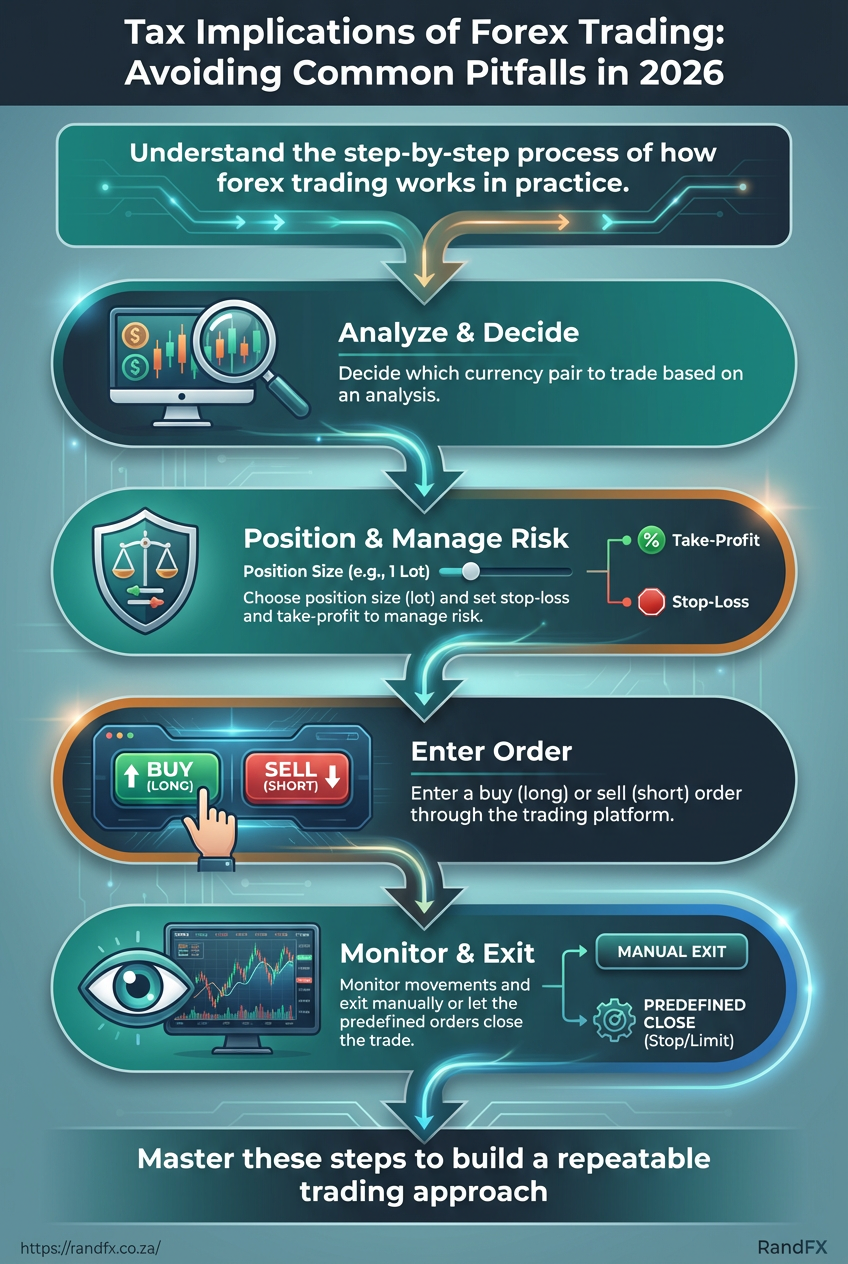
How trading works in practice:
- Decide which currency pair to trade based on an analysis.
- Choose position size (lot) and set
stop-lossandtake-profitto manage risk. - Enter a buy (long) or sell (short) order through the trading platform.
- Monitor movements and exit manually or let the predefined orders close the trade.
Why forex attracts traders
- High liquidity: Major pairs can be entered and exited quickly without large price impact.
- Accessibility: Retail platforms let individuals trade small sizes with modest capital.
- Around-the-clock markets: Trading spans time zones, so strategies can run outside standard business hours.
- Leverage availability: Enables larger exposures from smaller accounts — useful, but it must be respected.
Choosing the right execution environment matters. When comparing brokers, look for transparent spreads, execution speed, and regulation; for South African traders, a focused broker comparison helps reveal which firms offer suitable accounts and local support — see this compare forex brokers page for a practical starting point.
Start small, treat leverage like a multiplier for risk, and build familiarity with pip movements and spread behavior before scaling up. These basics make the difference between repeating losses and developing a repeatable approach.
Tax Obligations for Forex Traders in South Africa
Forex profits are taxable and South African Revenue Service expects traders to treat trading as a taxable activity whether trading part-time or full-time. Treating records, declarations and the right classification up front keeps you out of trouble and preserves returns after tax.
Understanding Tax Compliance
Tax compliance: Following SARS rules for reporting income, paying provisional tax, and keeping accurate records.
Why it matters: Non-compliance can trigger audits, penalties, interest and potential criminal charges if wilful evasion is found.
What SARS looks for: Consistent trading activity, pattern of gains/losses, business-like setup (platforms, software, records), and whether trading supports your livelihood.
Common practical points: Keep trade logs: platform statements, opening/closing times, position sizes, and screenshots for disputed fills. Separate accounts: using a dedicated trading account makes bookkeeping clear. * Invoices/receipts: costs for data feeds, courses or software are claimable where they relate to trading.
Key Tax Regulations to Know
Income tax implications: If trading is regular and profit-driven, SARS generally treats profits as income and taxes them at personal or corporate rates depending on your structure. One-off speculative wins may sometimes be treated differently, but consistent, commercially run trading is usually income.
Capital gains tax: If trading is an investor activity and not a business, profits might fall under capital gains. Capital gains tax only applies when an asset is disposed of; frequent active trading is less likely to qualify for CGT treatment.
Reporting requirements
- Register for an income tax reference if you don’t already have one.
- Track and report trading profits and allowable expenses on your annual ITR12 return.
- Lodge provisional tax if profits are significant or irregular so penalties for underpayment are avoided.
Practical example: treating subscription fees and platform commissions as deductible expenses reduces taxable income; the correct classification of a busy day-trader versus a long-term investor changes whether SARS expects income tax or CGT treatment.
When choosing a broker or switching platforms, consider how easily you can export statements for tax time — a clean export saves hours and reduces audit risk. For quick comparisons of brokers’ reporting features, see Compare forex brokers.
Handling tax properly protects capital and gives clarity when scaling trading activity. Keep good records, pick the right tax classification for your activity, and make provision for taxes so profit doesn’t disappear at year-end.
Common Tax Pitfalls and How to Avoid Them
Missing good tax hygiene quickly turns profitable forex trading into a headache. Two of the most frequent problems are poor record-keeping and underreporting income — both easy to prevent with disciplined habits and the right tools.
Neglecting to Keep Accurate Records
Good records make bookkeeping fast, audits straightforward, and tax filing accurate.
Why it matters: Accurate records prove trade dates, amounts, and outcomes when tax authorities ask for verification.
Best practices Consistent logging: Record every trade entry immediately, including date, currency pair, lot size, entry/exit price, and commissions. Separate accounts: Keep trading funds in accounts dedicated to trading to avoid mixing personal and trading transactions. Monthly reconciliation: Reconcile broker statements against your logs each month to catch errors early. Backup copies: Store backups in two different places (cloud + local) and export broker reports as CSV or PDF.
Tools for managing records
- Spreadsheet workflows: Use a simple
Google SheetsorExceltemplate with columns for P/L, fees, and trade reason. - Trading trackers: Consider purpose-built trackers that import
CSVfrom brokers and auto-calculate realized/unrealized P&L. - Accounting softwar e: Use tools that support capital gains reporting and integrate with tax reports.
Failing to Report All Income
Underreporting income — intentionally or not — carries penalties and interest. Transparency preserves credibility and avoids costly audits.
Risks: Penalties, interest on unpaid taxes, reputational harm with regulators, and in extreme cases, criminal exposure.
How to ensure full disclosure 1. Review broker statements and export all transaction history. 2. Compare broker-reported income to your records and resolve discrepancies. 3. Include non-trade income like interest, rebates, and affiliate earnings. 4. If unsure about classification (capital gain vs. ordinary income), consult a tax professional early, not at filing time.
Example: A trader forgot to include small interest credits from a clearing account; the omitted income triggered an adjustment and interest charges during a routine audit.
Randfx’s courses and market-analysis tools can help standardize record formats and train traders to capture every taxable event, if a structured option is needed. Solid record-keeping and full reporting remove uncertainty and keep focus on strategy rather than paperwork.
Tax Planning Strategies for Forex Traders
Tax planning for forex activity starts with treating trading as a business decision, not an afterthought. That changes how expenses are treated, what structures make sense, and how rigorous your record-keeping must be. Experienced traders use a blend of deductible expense capture, the right trading entity, and a repeatable process for claiming losses and gains.
Types of deductions available
Trading platform and data: Fees for platforms, real-time feeds, and subscription services are commonly deductible.
Education and research: Course fees, books, and paid research services tied directly to improving trading skills.
Home office: If a dedicated area is used exclusively and regularly for trading, a portion of rent, utilities, and equipment can be claimed.
Professional services: Accounting, tax advice, and legal fees related to trading activity.
Using deductions effectively requires linking each expense clearly to the trading activity. Keep receipts, invoices, and brief notes on how a purchase supports trading.
Record-keeping for deductions
- Gather transaction-level data from your broker and export trade history in CSV or PDF format.
- Save receipts and invoices in a dated folder structure or a cloud drive.
- Reconcile monthly: match broker statements to bank withdrawals and platform fees.
- Maintain a short memo for each unusual expense explaining why it’s trade-related.
What to record: trade date, instrument, size, entry/exit price, fees, and purpose for non-standard expenses. Use net capital gain = proceeds - cost basis when calculating per-trade outcomes for your tax worksheet.
Choosing the right trading structure
Sole trader: Simple setup and direct control. Profits taxed as personal income; losses can often offset other personal income depending on local rules.
Company / corporation: Offers liability protection and possible tax deferral. Retained earnings are taxed at corporate rates, and dividends incur additional tax events.
Partnership: Useful when trading with another person; profits pass through and are taxed at partners’ rates.
Trust: Provides estate planning flexibility and income-splitting opportunities but adds administration and compliance costs.
Picking a structure depends on turnover, risk tolerance, and long-term goals. If trading volume and capital grow, moving from sole trader to a company can reduce personal exposure and enable more sophisticated tax planning. Industry analysis shows that many active traders reassess structure when annual profits exceed a threshold where corporate tax treatment becomes beneficial.
Practical next step: document current costs, estimate annual profit, and run a simple comparison of after-tax outcomes under each structure. For brokers and execution considerations that affect taxable events, review platforms carefully—compare execution speed and fee transparency using resources like Compare forex brokers.
Thoughtful record-keeping plus the right entity choice turns a mess of receipts into predictable tax outcomes and fewer surprises at year-end.
Working with Tax Professionals
When trading forex becomes more than a hobby — frequent trades, larger accounts, multiple jurisdictions, or complex strategies like carry trades and hedging — bringing a tax professional on board saves time and reduces risk. A good advisor turns confusing tax rules into actionable numbers, helps avoid costly mistakes, and preserves trading capital through smarter tax treatment.
When to hire a tax professional
- Frequent trading activity: More than a few dozen taxable events per year makes DIY record-keeping error-prone.
- Complex instruments: Using forwards, swaps, or options creates reporting rules that vary by jurisdiction.
- Cross-border issues: Trading through foreign brokers or living in a different tax residence increases compliance complexity.
- Tax-loss harvesting needs: Coordinating sales to optimize losses requires planning, not last-minute fixes.
- Significant gains or audit risk: Substantial profits or unusual positions raise the value of professional review.
Benefits of professional advice
- Accuracy and compliance: Professionals understand local reporting rules and common mistakes that trigger audits.
- Tax-efficiency: Strategic timing of trades, entity structuring, and expense allocation can lower effective tax rates.
- Time savings: Outsourcing record reconciliation and filings frees up time for research and trading.
- Peace of mind: Having a documented rationale and support if tax authorities question your returns.
Cost vs. benefit analysis
- Estimate your current annual tax preparation and compliance time in hours and multiply by your hourly value.
- Get quotes from 2–3 tax professionals (CPA, tax attorney, international tax specialist) and compare flat fees versus hourly rates.
- Compare projected tax savings from professional strategies (e.g., better expense treatment, entity choice) against fees over a 12–24 month horizon.
- Include non-monetary value: reduced stress, lower audit probability, and the ability to scale trading without compliance gaps.
Practical example: a trader with 500 monthly transactions may spend 20–40 hours reconciling trades each quarter. Paying an expert a fixed fee to automate and file can be cheaper than the lost trading time and potential penalties from errors.
Recordkeeping: Keep broker statements, trade logs, and bank feeds organized; professionals can’t optimize what they can’t see.
RandFX’s market analysis tools and courses can make record reconciliation easier and provide transaction-level clarity when handing data to a tax advisor. Bringing a tax pro into the loop is an investment in sustainability — it protects gains and lets trading remain a growth activity, not a compliance headache.
📥 Download: Forex Trading Tax Compliance Checklist (PDF)
Conclusion
Tax consequences are a real, ongoing part of profitable forex trading — treat them like another market risk to manage. When trades generate gains, that’s taxable income in most jurisdictions; when losses occur, they create opportunities to reduce taxable exposure if handled correctly. Staying ahead of tax compliance keeps profits in your pocket and prevents surprise liabilities that can derail a trading plan.
Practical ways to reduce friction between trading and taxes: Record keeping: Keep detailed trade logs with timestamps, instruments, and realized P/L to simplify reporting and audits. Separate accounts: Use a dedicated trading account and a separate bookkeeping ledger to avoid mixing personal and trading cashflows. Understand residency: Know your tax residency rules — where you file determines which trades are reportable and which exemptions may apply. Leverage losses: Track realized losses precisely so they can offset gains where tax law permits, avoiding missed opportunities to lower tax bills. Use the right vehicle: Consider whether operating as an individual, a sole proprietor, or a formal entity makes sense for liability and tax efficiency. Professional review: Schedule an annual tax review with someone familiar with forex tax issues to catch opportunities and compliance gaps.
Step-by-step actions to close the year cleanly: 1. Reconcile your trade journal against broker statements. 2. Categorize realized vs. unrealized gains and losses. 3. Document commissions, spreads, and margin interest as deductible expenses where allowed. 4. Consult a tax specialist before filing to confirm treatment of complex items like swaps, carry trades, or cross-border brokers.
traders recognize: treating broker fees as deductible expenses reduces taxable income; converting a consistently active trading operation into a registered entity can change how social contributions and corporate taxes apply.
Make tax compliance a routine part of trading operations rather than an afterthought. It preserves capital, reduces stress during filing season, and aligns trading strategy with long-term financial goals. Keep records tidy, check residency rules, and get a specialist involved when positions, jurisdictions, or volumes make the tax picture complex — that discipline often pays for itself.
Conclusion
Trading profitably is one thing; staying ahead of the tax implications is another. After walking through trading basics, how South African tax rules treat trades, common pitfalls, and practical planning strategies, the sensible next moves are clear: keep meticulous records of every trade, separate personal and trading accounts, and treat tax planning as part of your trading strategy. For traders who scalp intraday gains versus those holding positions longer, the examples earlier show how classification and documentation change outcomes — what looks like a small bookkeeping oversight can trigger a costly reassessment. Many traders also wonder whether their activity counts as a business, how to handle forex-to-crypto conversions, or when to consult an accountant; those questions usually hinge on trading frequency, intent, and documentation.
Start by organizing last year’s statements and mapping trades to profit/loss categories, then book a short consultation with a tax professional if anything feels uncertain. For practical comparison of operational features that affect tax compliance — like reporting tools, base currencies and fee structures — consider this useful next step: Compare forex brokers to find the best fit for your trading needs. Taking these three actions—better records, clearer account setup, and smarter broker choice—will reduce audit risk and make tax compliance a manageable part of profitable forex trading.