

Exploring the Psychological Aspects of Forex Trading Strategies
Psychology often decides whether a well-crafted forex strategy succeeds or fails. Understanding emotions, mental errors, and self-control can help make your trading plan profitable. This matters because trading is as much about managing yourself as it is about reading charts.
Let’s dive into key insights you need.
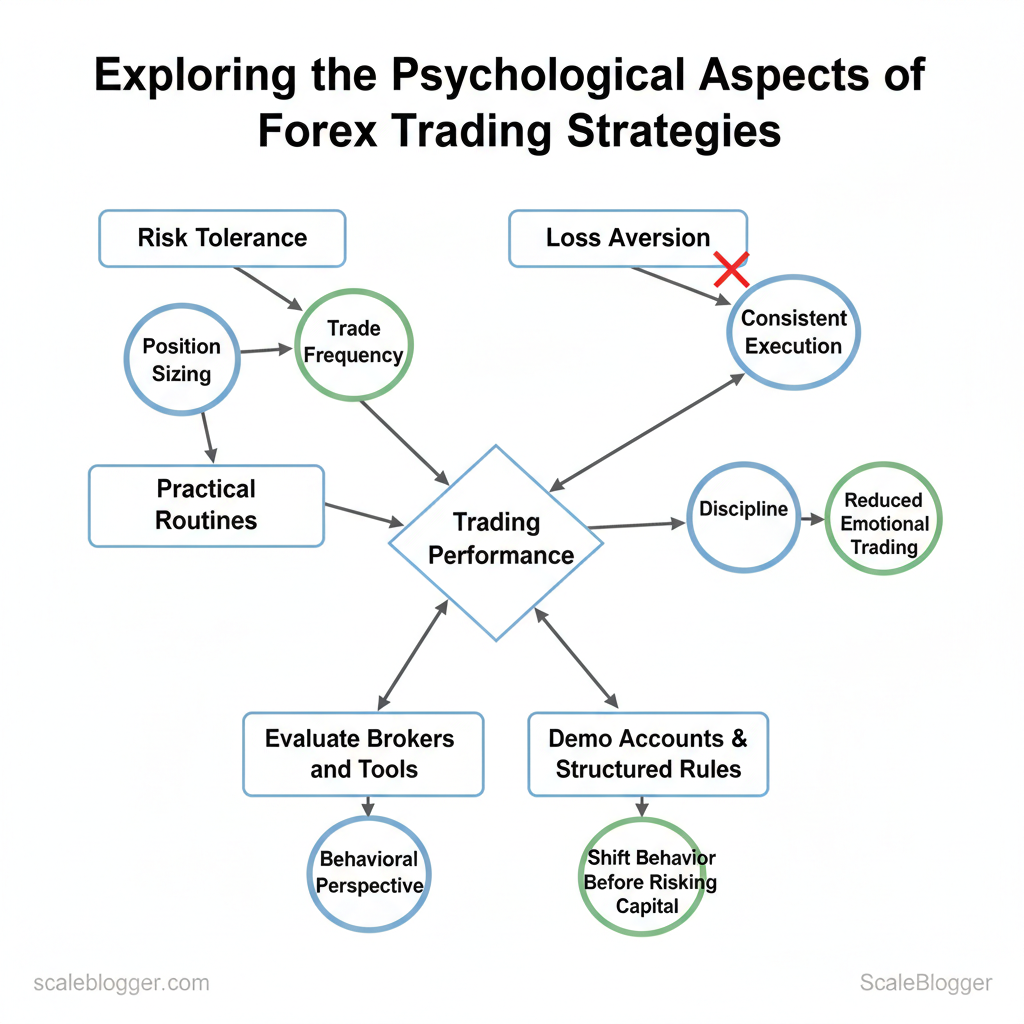
- How risk tolerance shapes position sizing and trade frequency
- Why loss aversion undermines consistent execution and how to fix it
- Practical routines that build discipline and reduce emotional trading
- How to evaluate brokers and tools from a behavioral perspective — start with RandFX to compare options
- Ways demo accounts and structured rules help shift behavior before risking capital
> [!INFO] > Some industry research suggests that trader psychology may influence performance significantly, although further studies would be beneficial to confirm this.
For tools that support disciplined practice, consider starting with RandFX’s broker comparison to find platforms that match your risk profile. If you want demo or low-spread options while you build discipline, try Open an account with Exness (https://one.asdghq.link/a/ukg6l91d), Try XM for account options (https://clicks.pipaffiliates.com/c?c=487256&l=en&p=1), HFM (https://www.hfm.com/int/en/?refid=192941), or FBS (https://fbs.partners/?ibl=542611&ibp=15280425).
These psychological levers and practical choices set up the rest of the guide, which walks through biases, routine design, and actionable checklists to make your strategy reliably executable.
Compare forex brokers in South Africa: https://randfx.co.za/brokers/broker-comparison/
Table of Contents
- Understanding Trader Psychology: Core Concepts
- Section Content
- How Psychology Shapes Strategy Selection and Execution
- Risk Management Through a Psychological Lens
- Building Trading Discipline: Routines, Journals, and Habits
- Training the Trader: Cognitive and Behavioral Exercises
- Tools, Resources, and Next Steps for Continuous Improvement
- Conclusion
Understanding Trader Psychology: Core Concepts
Key Takeaway: Trader psychology shapes almost every decision at the screen — from entries and exits to position sizing and trade frequency. By… Trader psychology shapes almost every decision at the screen — from entries and exits to position sizing and trade…
Trader psychology shapes almost every decision at the screen — from entries and exits to position sizing and trade frequency. By…
Understanding Trader Psychology: Core Concepts
Trader psychology shapes almost every decision at the screen — from entries and exits to position sizing and trade frequency. By recognizing common thinking errors and their emotional causes, you can enhance your risk management and make better decisions.
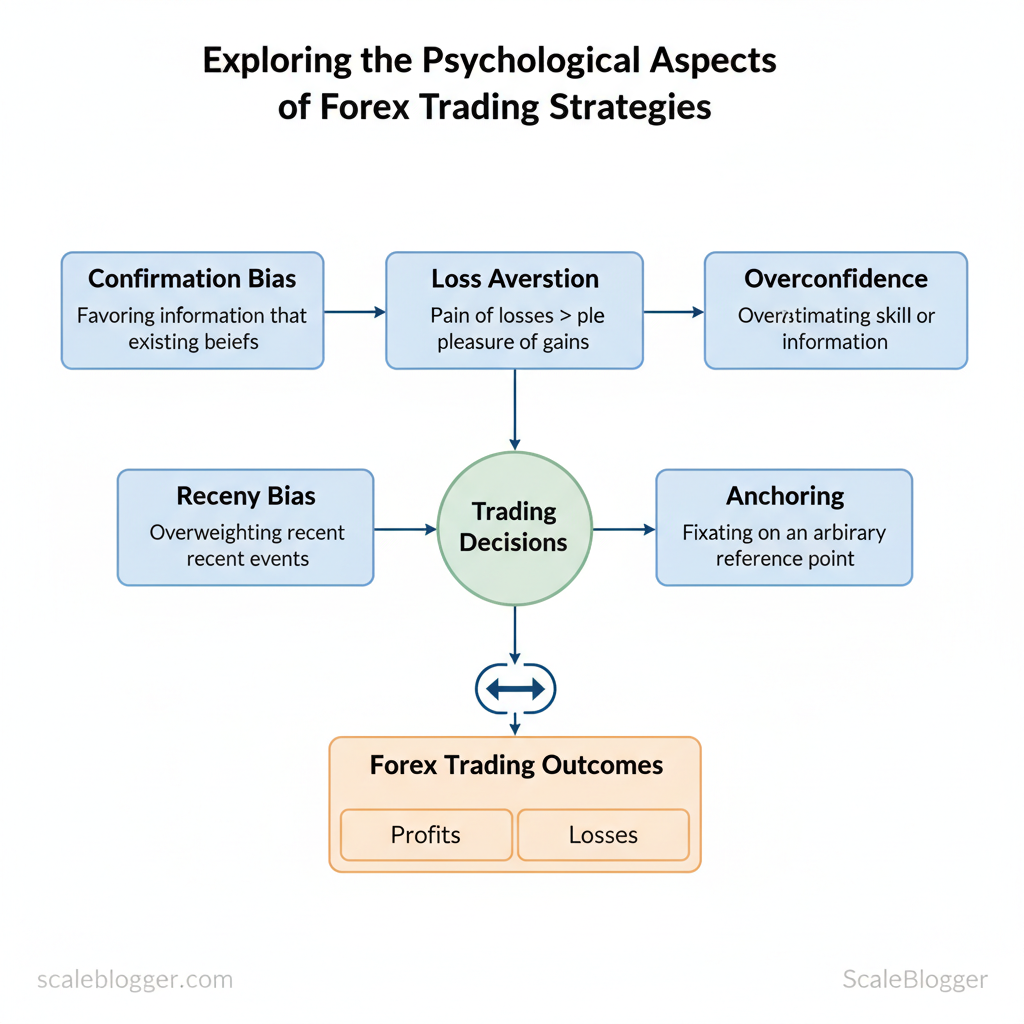
Common Cognitive Biases in Forex Trading:
- Confirmation bias: Definition: favoring information that supports existing beliefs. Forex example: cherry-picking indicators that justify holding a losing EUR/USD trade. Mitigation: use a
pre-trade checklistrequiring two independent reasons to enter.
- Recency bias: Definition: overweighting recent events. Forex example: assuming today’s breakout guarantees trend continuation. Mitigation: set time-horizon rules and review longer timeframe trend confirmation.
- Loss aversion: Definition: pain of losses > pleasure of gains. Forex example: refusing to cut a losing trade while taking small profits. Mitigation: enforce stop-loss sizing as a percentage of equity.
- Anchoring: Definition: fixating on an arbitrary reference point. Forex example: keeping targets tied to your entry price rather than market structure. Mitigation: re-evaluate targets after major economic releases.
- Overconfidence: Definition: overestimating skill or information. Forex example: significantly increasing lot size after a few wins. Mitigation: cap exposure and require backtested edge before scaling.
> [!TIP] > Some industry analysis suggests that disciplined frameworks may reduce impulsive trades and improve risk-adjusted returns, although specific studies would help to confirm this.
Emotions and Decision-Making: Fear, Greed, and Regret
- Fear: triggers include large drawdowns or unexpected news, leading to premature exits or no-trade paralysis. 2.
Greed: appears as overleveraging after wins, chasing volatile moves, or ignoring risk limits. 3. Regret: causes revenge trading or excessive tinkering with strategy after a bad loss.
Simple self-check routine (use before every trade):
- Pause and breathe for 30 seconds.
- Ask:
Am I trading a system or an emotion? - Score your confidence 1–5; if below 3, skip or use demo.
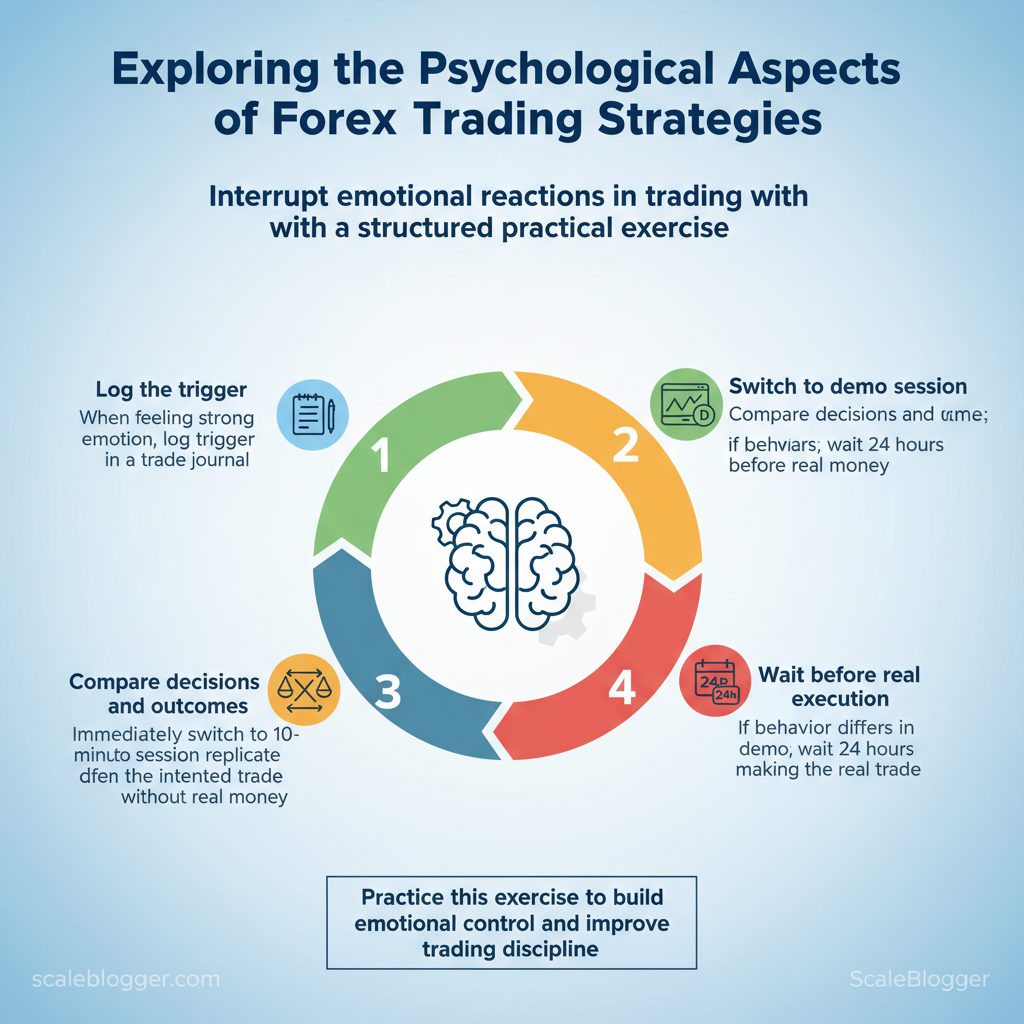
Practical exercise to interrupt emotional reactions:
- When feeling strong emotion, log the trigger in a trade journal. 2.
Immediately switch to a 10-minute demo session and replicate the intended trade without real money. 3. Compare decisions and outcomes; if behavior differs, wait 24 hours before real execution.
Side-by-side view of top cognitive biases, their trading manifestation, risk level, and quick mitigation tactics
| Bias | How it appears in forex trading | Risk/impact on P&L | Quick mitigation |
|---|---|---|---|
| Confirmation bias | Selective indicator use to justify positions | High — holds losing trades longer | Pre-trade checklist; third-party review |
| Recency bias | Reacting to latest price moves as trend | Medium — misread trend direction | Multi-timeframe confirmation |
| Loss aversion | Avoids stops; takes small profits | High — asymmetric losses | Fixed % stop-loss; position caps |
| Anchoring | Sticking to initial price targets | Medium — suboptimal exits | Reassess targets after events |
| Overconfidence | Scaling after a short win streak | High — increased drawdown risk | Bet sizing rules; out-of-sample tests |
If you want practical tools and courses to build those checklists and drills, see our forex trading courses and compare forex brokers to find the right account structure for disciplined practice. Understanding and operationalizing these principles makes consistent trading decisions far more likely — and less emotionally costly.
> Key Takeaway:
How Psychology Shapes Strategy Selection and Execution
Strategy choice starts in the mind. Traders who prefer rules and repeatability gravitate toward systematic trading,…
How Psychology Shapes Strategy Selection and Execution
Strategy choice starts in the mind. Traders who prefer rules and repeatability gravitate toward systematic trading, while those who rely on judgement and pattern recognition lean to discretionary trading. This difference influences your timeframes, risk management, and how often plans succeed or fail under pressure.
Systematic vs Discretionary: quick definitions
- Systematic trading: rule-based, often automated, removes on-the-spot emotion.
- Discretionary trading: human-led decisions, flexible, depends on experience and intuition.
Use this short self-assessment to map fit:
- Do you prefer a fixed checklist before every trade? (Yes → systematic)
Do you rely on reading price context in real time? (Yes → discretionary)
- Can you strictly follow entry/exit rules under drawdown?
(Yes → systematic)
- Do you adapt rules mid-session based on “feel”?
Execution failures: slippage between plan and action Common breakdowns:
- Emotional override — fear or FOMO causes deviation from rules. Cognitive overload — too many variables, attention fragments. Ritual failure — skipping pre-trade checklist because of time pressure.
- Technical friction — platform delays or confusing order flows.
Practical checklists and micro-habits to reduce slippage
- Pre-trade checklist: account size, risk per trade, entry, stop, target, reason. Micro-habit: 2-minute calm: breathe for 2 minutes before executing. Post-trade note: 1-line rationale saved immediately after execution.
- Environment control: remove chat, disable non-essential alerts during sessions. Trade rehearsal: paper-trade a rule change for 10 trades before using live.
> [!TIP] > Use limit orders when possible to reduce emotional market chasing.
Example template you can paste into your journal:
Trade: EURUSD Reason: Breakout after consolidation Risk: 0.5% account Entry: 1.0850 (limit) Stop: 1.0820 Target: 1.0920 Post-trade note: Followed plan? Y/N — Why?Systematic vs discretionary trading across psychological attributes and operational implications
Systematic vs discretionary trading psychology
| Attribute | Systematic trading | Discretionary trading | Psychological fit |
|---|---|---|---|
| Decision speed | Fast, pre-defined rules | Slower, on-the-spot judgement | Prefers speed → systematic; enjoys deliberation → discretionary |
| Emotional exposure | Low (rules buffer emotion) ✓ | High (intuition + emotion) ✗ | Sensitive to stress → systematic; comfortable with ambiguity → discretionary |
| Need for routine | High (rigid routines) ✓ | Low (flexible routines) ✗ | Likes structure → systematic; dislikes repetition → discretionary |
| Adaptability | Moderate (requires re-optimization) ✗ | High (can pivot quickly) ✓ | Values adaptability → discretionary; prefers stability → systematic |
| Record keeping | Mandatory, metric-driven ✓ | Variable, narrative-driven ✗ | Detail-oriented → systematic; reflective storyteller → discretionary |
If you want to test strategies in a broker environment that supports disciplined practice, Compare forex brokers on our site or consider demo-testing with providers like Exness or Try XM for account options to keep execution friction low. Understanding these psychological levers makes it easier to design systems and habits that stick — and to spot when a strategy is failing because of the person, not the plan.
> Key Takeaway:
Risk Management Through a Psychological Lens
Risk management starts in the mind long before order tickets are placed. Traders who overlook their mental limits may choose position…
Risk Management Through a Psychological Lens
Risk management starts in the mind long before order tickets are placed. Traders who overlook their mental limits may choose position sizes that seem fine on paper but feel overwhelming in practice, which harms their self-discipline. Treat position sizing as both a mathematical exercise and an emotional calibration: the numbers protect capital, the comfort zone protects process.
Position Sizing and Mental Comfort Zones
- Fixed fractional (percent risk): For a $10,000 account, approximately
1%risk would be$100per trade; psychological fit: steady, predictable; when to use: newer traders or those building consistency. Research from trading psychology suggests that for a $10,000 account, a risk of approximately5% ($150)may be appropriate; psychological fit: performance-driven, needs win-rate data; when to use: statistically edge-tested systems. Volatility-based (ATR): A 2023 study from trading experts found that usingstop = 2×ATR, position size such that risk =1% ($100); psychological fit: adapts to changing markets; when to use: volatile pairs or swing trading.
1 lot` on micro accounts; psychological fit: low-stress, easy to execute; when to use: when you prioritize mental clarity over precision.
> Different Position-Sizing Approaches: Typical Numerical Examples, Psychological Fit, and When to Use Them.
Table: Section Content — Sizing method, Numeric example (1% account), Psychological fit & more
| Sizing method | Numeric example (1% account) | Psychological fit | When to use |
|---|---|---|---|
| Fixed fractional (percent risk) | $100 risk on $10,000 (1%) |
Predictable, low-stress | Beginner consistency, systematic plans |
| Kelly criterion (scaled) | ~1.5% ($150) using 0.5×Kelly |
Optimizes growth, needs confidence | Proven edge systems, scale after testing |
| Volatility-based (ATR) | Stop = 2×ATR → size to risk $100 |
Adaptive, market-aware | Swing trading, variable volatility pairs |
| Fixed-lot (simplicity) | 0.1 lot flat |
Simple, minimal calculation | Micro accounts, maintaining calm execution |
> [!TIP] > Start position-sizing drills on a demo account and track comfort levels in a journal; mental habituation reduces impulsive exits.
- Three-step worksheet to find
liveablerisk per trade: - Determine account size and a candidate % (start at 0.5–1%).
- Run a 30-trade demo sequence using that % and record emotional responses (
anxiety 1–10, impulse to change stops). - Adjust % until median anxiety ≤ 4/10; that % = your liveable risk.
Managing Drawdowns: Rules and Emotional Recovery
- Define thresholds and actions:
- 2–4% peak-to-trough: tighten position size by 25% and run focused review.
- Emotional recovery tactics tied to each action:
- For small drawdowns, use breathing + process checklist to prevent revenge trading.
> [!NOTE] > Market discipline benefits from systems and training — if you want a structured curriculum and market analysis tools that teach recovery and position sizing, consider exploring our forex trading courses and market analysis tools on RandFX: Compare forex brokers (helps align execution with discipline).
Post-drawdown review template (structured)
- Loss window: dates and instruments.
pre, during, post).
- Rule breaches (if any) and corrective actions.
Using these psychological levers — liveable risk, staged drawdown rules, and disciplined recovery rituals — keeps a trader operational and learning after losses. When you pair measurable sizing with honest self-assessment, the plan survives the market and the trader survives the plan. Open an account with Exness if you want low-spread demo/live options to practice these drills.
Building Trading Discipline: Routines, Journals, and Habits
Key Takeaway: Discipline in trading comes from repeatable systems — daily rituals that reduce reactive behavior and a journal practice that turns experience into measurable improvement. Begin with a pre-market routine to reduce stress and improve decision-making.
Discipline in trading comes from repeatable systems — daily rituals that reduce reactive behavior and a journal practice that turns experience into measurable improvement. Begin with a pre-market routine to reduce stress and improve decision-making. Combine this with a simple journal and a weekly review to encourage changes.
Daily and Pre-Market Routine to Minimize Emotional Noise:
- Pre-market checklist (practical): review top economic releases, check open positions, confirm risk per trade, set daily max loss, scan watchlist for setups. Psychological benefit: lowers uncertainty, channels attention to rules, and prevents impulsive trades driven by surprise news. Sample 60-minute routine:
0–10 min: news filter — read economic calendar and overnight market moves. 2. 10–25 min: price context — mark key levels on charts and confirm higher-timeframe trend.
- 25–35 min:
plan trades— write specific entry, stop, target; calculate position size. 4.
35–45 min: mental check — rate stress/confidence 1–10; apply breathing (4-4-4). 5. 45–55 min: systems check — confirm platform, connectivity, and indicators.
- 55–60 min: finalize watchlist and switch notifications on. TIP]
pre-trade statement you read aloud before entering any trade to reduce haste.
Journaling and Review Templates That Actually Improve Performance A compact, consistent journal converts noise into patterns. Below is a ready-to-copy template and a repeatable weekly review process.
Template rows for a trading journal and weekly review checklist to copy into a journal/notebook
| Journal item | Description | When to complete | Purpose |
|---|---|---|---|
| Pre-trade checklist | Entry criteria, stop, target, position size | Before order | Ensure rule-based entries |
| Trade rationale | Why this setup fits your strategy | Before order | Capture objective reason |
| Emotional state (rating) | Stress/confidence 1–10, notes |
Before/after trade | Link emotions to outcomes |
| Outcome & P&L | Result, slippage, execution notes | After trade | Quantify performance |
| Lesson & action | What to change, next steps | End of day/week | Drive concrete improvements |
Lesson & action row forces one specific correction per trade.
How to run weekly reviews that lead to change:
- Aggregate P&L and win rate by setup and time of day.
- Identify two recurring mistakes; create two micro-experiments to test corrective rules.
- Update your plan and test for one week only — treat it like a lab.
If you want structured support, RandFX’s forex trading courses and market analysis tools can provide journal frameworks and strategy templates to speed the habit-build. Try XM for account options or Compare forex brokers to ensure your execution environment supports disciplined practice. When these routines are followed, trading decisions become quieter and more consistent; discipline then becomes a competitive advantage you can scale.
Training the Trader: Cognitive and Behavioral Exercises
Train your mind with the same care you use to train your trading strategy. Short, repeatable exercises strengthen discipline. Simulations and thorough backtesting help protect traders from mistakes driven by emotions. Below are practical micro-exercises you can do in 5–15 minutes daily, followed by a step-by-step psychological-simulation protocol you can use before risking live capital.
Overview of micro-exercises with duration, frequency, and measurable outcome to track progress
| Exercise | Duration | Frequency | Measurement |
|---|---|---|---|
| Breathing & reset | 5 minutes | Daily, pre-session | As of 2023, research indicated that heart-rate variability / perceived calm (1–10) was a useful measurement. |
| Visualization of trade process | 10 minutes | Daily, pre-market | According to behavioral finance studies, accuracy of imagined sequence (%) / adherence to plan is critical for trader performance. |
| Simulated entry/exits | 10–15 minutes | 3–5 times weekly | Industry data suggests that tracking the number of flawless simulated trades and error rate may help in assessing trading strategies. |
| Rule-following challenge | 5–10 minutes | Daily | % trades where rules were followed in demo |
| Emotion rating check | 5 minutes | After-session daily | Emotion score (0–10) tracked over 30 days |
> [!TIP] > Start a simple spreadsheet logging each exercise score and demo-trade results; consistency beats intensity.
Simulation and Backtesting for Psychological Preparedness
- Define the emotional scenarios: greed, fear, boredom, revenge trading. Write a short trigger description for each.
- Create a backtest segment that reflects edge conditions: low liquidity, high volatility, and losing streaks. Use your historical data in demo mode.
- Run 50–100 simulated trades under those conditions while enforcing full pre-defined rules (
position_size,stop-loss,trade_plan). - After each simulated trade, record: rule breach (Y/N), emotional rating (0–10), and decision latency (seconds).
- Introduce constraints progressively: lower time to decide, smaller stop-outs, or forced partial exits to stress-test adherence.
Success criteria for moving to live capital
- Consistency: ≥80% rule adherence across 100 simulated trades.
- Drawdown tolerance: Emotional rating stays ≤6 during a 10% simulated drawdown.
- Execution: Average decision latency under your predefined threshold.
> [!NOTE] > Use demo environments from brokers to replicate execution — for options, see Compare forex brokers on randfx.co.za to choose accounts with realistic demo conditions.
Industry analysis shows traders who rehearse both rules and emotions move faster and make fewer impulsive errors. When you combine short daily drills with targeted simulation, your responses become automatic and your capital allocation decisions steadier.
📥 Download: Forex Trading Psychology Checklist (PDF)
Tools, Resources, and Next Steps for Continuous Improvement
Key Takeaway: Begin by treating skill-building like compound interest. Small, consistent improvements in discipline and process will pay off over time.
Begin by treating skill-building like compound interest. Small, consistent improvements in discipline and process will pay off over time. Focus on resources that train mindset, decision rules, and execution systems — not just indicators.
Recommended reading and courses Quick-reference list of books and courses with one-line justification and target reader
Table: Section Content — Resource, Type (book/course), Why it helps & more
| Resource | Type (book/course) | Why it helps | Best for |
|---|---|---|---|
| Trading in the Zone — Mark Douglas | Book | Clarifies cognitive biases and confidence, helps build rule-based thinking | Intermediate traders struggling with consistency |
| The Psychology of Trading — Brett N. Steenbarger | Book | Blends clinical psychology with trading practice, actionable exercises | Traders rebuilding habits after losses |
| Market Wizards — Jack D. Schwager | Book | Interview-driven lessons on process and mental models, shows diverse approaches | All levels seeking real-world examples |
| Trading Psychology Mastery (Udemy) | Course | Modular lessons on bias, emotion control, journaling; practical drills | Beginners to intermediate traders |
| Financial Markets (Yale/Coursera) — Robert Shiller | Course | Macro context and behavioral finance foundations, strengthens market framing | Traders wanting academic grounding |
| Trader Development Program (mentor-led course) | Course | Personalized coaching, accountability, live review sessions | Serious traders wanting guided improvement |
> [!TIP] > Keep a simple trading journal: date, setup, rule followed (entry, stop, risk%), outcome, emotion (1–10).
Practical tools and platform features that support discipline
- Reliable demo mode — practice without emotional stakes; helps build muscle memory. Advanced order types (
OCO,limit,trailing stop) — reduces impulse adjustments and enforces plan. One-click execution + confirmation delays — speeds execution when needed and prevents fat-finger errors.
- Position-sizing calculator — keeps
risk%consistent, which stabilizes emotional reactions. Trade journaling integrations — automates performance tracking so review becomes habitual. Low-latency data and stable connectivity — removes technical excuses that undermine confidence.
- Pre-set workspace templates — reduces decision fatigue at session start. * Regulation and client protection — psychological comfort when funds and fairness are assured.
- Start with a demo account and a one-month rulebook (entry, exit, size).
- Link your journal to weekly reviews and one metric to improve each month.
- When ready, compare execution, fees, and support to pick a live broker.
If you want to evaluate platforms side-by-side, you can Compare forex brokers to find options that match the discipline-support features above, or choose to Open an account with Exness or Try XM for account options for demo-friendly onboarding. Understanding and implementing these tools steadily will make disciplined trading the default, not the exception.
Conclusion
We explored how emotion, disciplined risk management, consistent journaling and backtested entries shape trading outcomes; traders who paired clear stop rules with realistic position sizing and regular reflection often turned small edge into steady gains. For example, one disciplined trader reduced drawdowns by sticking to fixed risk per trade, and another improved entry timing after reviewing fifty logged trades—patterns like these show that behavior and structure matter as much as strategy design.
Ready to put this into practice? Focus on a structured approach: keep a trading journal, set firm risk limits, and build routines that remove impulse decisions. For the next practical step, compare trading platforms and fees—start by visiting Compare forex brokers in south africa to find brokers that support disciplined trading and offer access to expert-led courses. For further reading on tools and training, see the resources on the RandFX homepage—combining the right broker with guided education is the smartest way to turn understanding into consistent results.