

Imagine closing a trade at a loss you didn’t plan for.
The chart looked fine.
The analysis was sound.
What broke down was something harder to see, and it’s the same thing that separates the traders who last from the ones who quietly stop.
Trading psychology rarely fails in dramatic fashion.
It fails in small, repeatable moments: moving a stop, doubling size after a win, abandoning a strategy three days before it would have worked.
Successful forex traders don’t feel less fear or greed.
They build systems that make those emotions expensive to follow.
That means fixed rules for entries and exits, a written process for diagnosing why a bad trade happened, and a way to verify the plan is actually being followed.
This guide treats the mindset behind profitable trading the way you’d treat any other part of your process.
You’ll work through the inputs, the decision rules, and the failure points, step by step.
Quick Answer: Successful forex traders focus on consistent decision-making rather than just trying to manage emotions like fear and greed. By implementing fixed rules for entries and exits and adhering to a written process, traders can avoid costly deviations from their plans, leading to improved trading outcomes. This disciplined approach enables traders to execute strategies effectively, even under market pressure.
What Trading Psychology Means for Forex Results
A trader spots a clean EUR/USD setup, follows every rule in his plan, and takes the loss. Twenty minutes later he doubles his position on a hunch, incurring a significant loss beyond planned limits.
While the analysis was sound, the real failure lies in not adhering to established rules under pressure. This highlights trading psychology’s essence – the capacity to maintain consistency despite market fluctuations.
Why Fix the Trader Before the Strategy
Traders often attempt to modify their strategy following losses, adopting new indicators and methods in search of improvement. However, this frequently leads to similar outcomes as they continue to repeat the same patterns. Addressing the gap between knowing and executing rules is paramount—this pivotal realization ensures a trader can maintain composure under pressure.
Commit to executing the strategy previously set before approaching the charts again; failure to do so renders any strategy ineffective.
Define the Outcome: Consistent Decisions Under Pressure
The ultimate goal is to achieve not calmness but consistent decision-making. The aim should be to ensure that regardless of monthly profits or losses, the same decisions are made, maintaining consistency in position sizing, stop placement, and risk assessments. This can be summarized through real-time checklists to verify adherence to these predetermined rules.
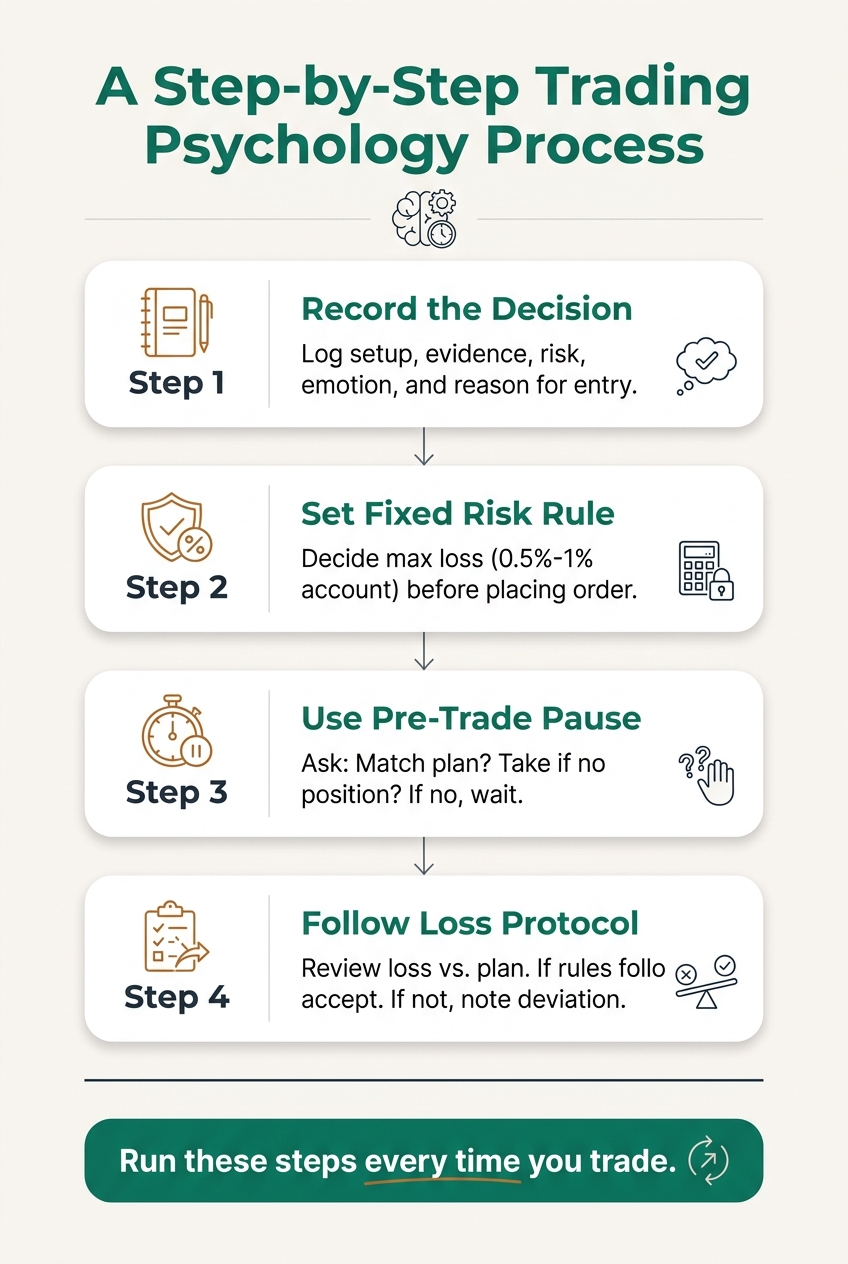
A Step-by-Step Trading Psychology Process
Here’s how we can develop a trading psychology process step-by-step.
Discipline is an emotion that can be nurtured and cultivated.
It is a process you can run the same way on a quiet Tuesday and a chaotic Friday afternoon.
The sequence below turns intention into habit.
Each step includes a completion check, so you know it is working rather than just feeling better.
- Record the decision, not only the result. Before you close the platform, log the setup you saw, the evidence behind it, the risk you accepted, your emotional state on a 1–5 scale, and the reason you entered. A journal that says only “+R400” tells you nothing about why the trade happened. Success check: you can read the entry a week later and explain exactly what you were thinking.
- Set a fixed risk rule before you enter. Decide the most you will lose on a single position — commonly
0.5%to1%of account equity — and write it down before placing the order. If a setup needs a wider stop than the rule allows, skip it or reduce size. Success check: you never move a stop to avoid a loss.
- Use a pre-trade pause to separate evidence from impulse. Sixty seconds is enough. Ask two questions: does this entry match a written condition in my plan, and would I take it if I had no position open? If either answer is no, you wait. Success check: you can name the exact plan condition that triggered the entry.
- Follow a loss protocol instead of improvising. After a losing trade, step away for a fixed period — even five minutes — and review the loss against your plan. If the loss followed your rules, accept it and move on. If it did not, write down the deviation. Do not re-enter to “make it back.” Success check: your next trade is based on a fresh setup, not on recovering the last loss.
Run these steps in order every time you trade.
The process, not motivation, is what keeps your psychology stable when the market is not.
How Successful Forex Traders Handle Common Mental Traps
We aren’t necessarily better forecasters than other traders.
They are better at running a fixed response when a mental trap fires.
Start before the first trade.
Three losses in a row is where most sound plans get abandoned, so set a written circuit breaker: after three consecutive losses, either drop position size by half or stop trading until the next session.
Pick one, write it down, and treat it as non-negotiable.
Success looks like your fourth trade following the plan—or not happening at all.
Manage uncertainty instead of forecasting outcomes.
Nobody knows the next candle.
What you control is risk per trade, entry conditions, and your exit.
Price the unknown into your sizing rather than trying to predict it away.
Success looks like you execute only the process you can define, even when the chart is “unclear.”
When analysis turns into hesitation, use a checklist.
Staring at a chart for twenty minutes hunting extra confirmation means your process has no exit condition.
Reduce the decision to five or seven written conditions—trend, level, session, spread, risk—and give yourself a hard time limit.
If the checklist isn’t complete in ten minutes, the answer is no trade.
Success looks like fast, boring decisions you can explain afterwards.
When confidence turns into overtrading, cap the day.
A winning streak feels like proof of skill, but your plan still needs boundaries.
Set a maximum number of trades for the day (or a hard stop on additional risk once you’ve hit your target), then follow it without negotiating.
Success looks like you end the day with the same rules intact—no “one more” attempt after the trap has already started.
Verify Your Trading Psychology and Choose the Next Practice
How do you know your trading psychology actually changed? A profitable week is not proof, and neither is feeling calm.
The only reliable evidence is a written record of what you did against what your rules said.
This process ends with a review rather than a result.
Block twenty minutes at the same time every week, open your journal, and compare seven days of entries against your written plan.
Read the entries in a fixed order and score each one against a single question.
Start with behavior and rule-following, not P&L.
Profit can hide broken rules, and losses can hide sound decisions.
Work through this once per week, row by row, before you adjust anything.
Success looks like: every entry aligns with your planned conditions, risk is respected without exceptions, and you execute your process consistently.
| Review question | Evidence to inspect | Pass condition | Next adjustment |
|---|---|---|---|
| Did I follow my entry rules? | Timestamped entries versus written setup conditions | Every entry matches a written condition | No entry without a confirmed setup next week |
| Did I respect my risk limit? | Position sizes and stop distances on each trade | No trade breaches the daily risk cap | Reduce position size by one step |
| Did I pause before impulsive actions? | The time between your signal check and order placement (and any skipped pre-trade steps) | You followed your planned pause before placing the trade | Add one deliberate pre-entry step next week |
Then repeat the same weekly block so the record, not the mood, shows the change.
What is the best trading strategy in 2026?
The best trading strategy in 2026 emphasizes discipline and adherence to fixed rules for entries and exits. Successful traders focus on maintaining consistent decision-making rather than relying on forecasts or adapting strategies impulsively following losses.
Is forex trading still profitable in 2026?
Forex trading remains profitable in 2026 for those who cultivate strong trading psychology and discipline. Maintaining a systematic approach allows traders to manage risk effectively and navigate market fluctuations, providing opportunities for gains.
What is the 3-5-7 rule in forex trading?
The 3-5-7 rule in forex trading is a guideline for managing losses by implementing a written circuit breaker. After experiencing three consecutive losses, traders should either reduce their position size by half or refrain from trading until the next session.
What is the most successful strategy in forex?
The most successful strategy in forex is built around rigorous adherence to a written plan, which includes fixed rules for entering and exiting trades. This discipline helps traders manage their emotions and avoid costly deviations from their strategies.
How to master discipline in trading?
To master discipline in trading, establish a systematic approach that includes recording decisions and emotional states during trades. Creating a trading journal, following a step-by-step process, and regularly reviewing past trades against your rules can significantly enhance consistency and adherence to your strategy.
Running the Process When the Market Tests You
That off-plan exit wasn’t just a discipline failure.
It was a missing rule.
The traders who bounce back fastest are the ones who wrote the entry condition, the stop, and the exit trigger before the chart ever moved — everything else is improvisation wearing a strategy’s clothes.
So start small tonight.
Log your next three trades with the rule you followed and the emotion you felt while following it. Do that for two weeks and your own patterns will surface faster than any lesson can hand them to you.
One last check worth doing: if spreads or execution speed keep distorting your fills, Sometimes the edge fails at the platform, not in your head.