
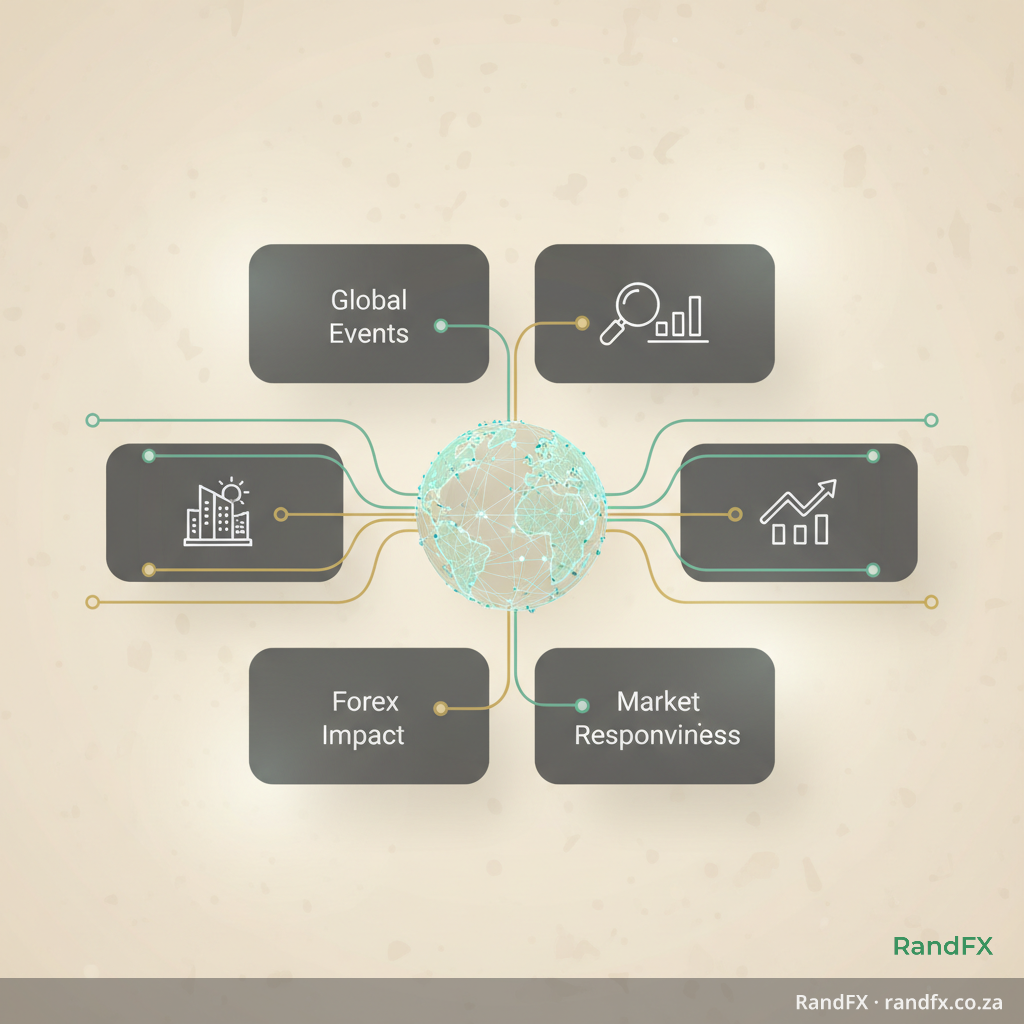
Checking the calendar on Sunday night can show an FOMC decision, US inflation data, and a geopolitical risk before your trading day starts in Johannesburg.
By the time you look at a chart, prices might already reflect what people expect, not just the main news.
Global events don’t move forex in just one clear way.
For example, a stronger inflation report can help a currency by raising interest-rate hopes. But the market might also drop if traders worry about slower growth.
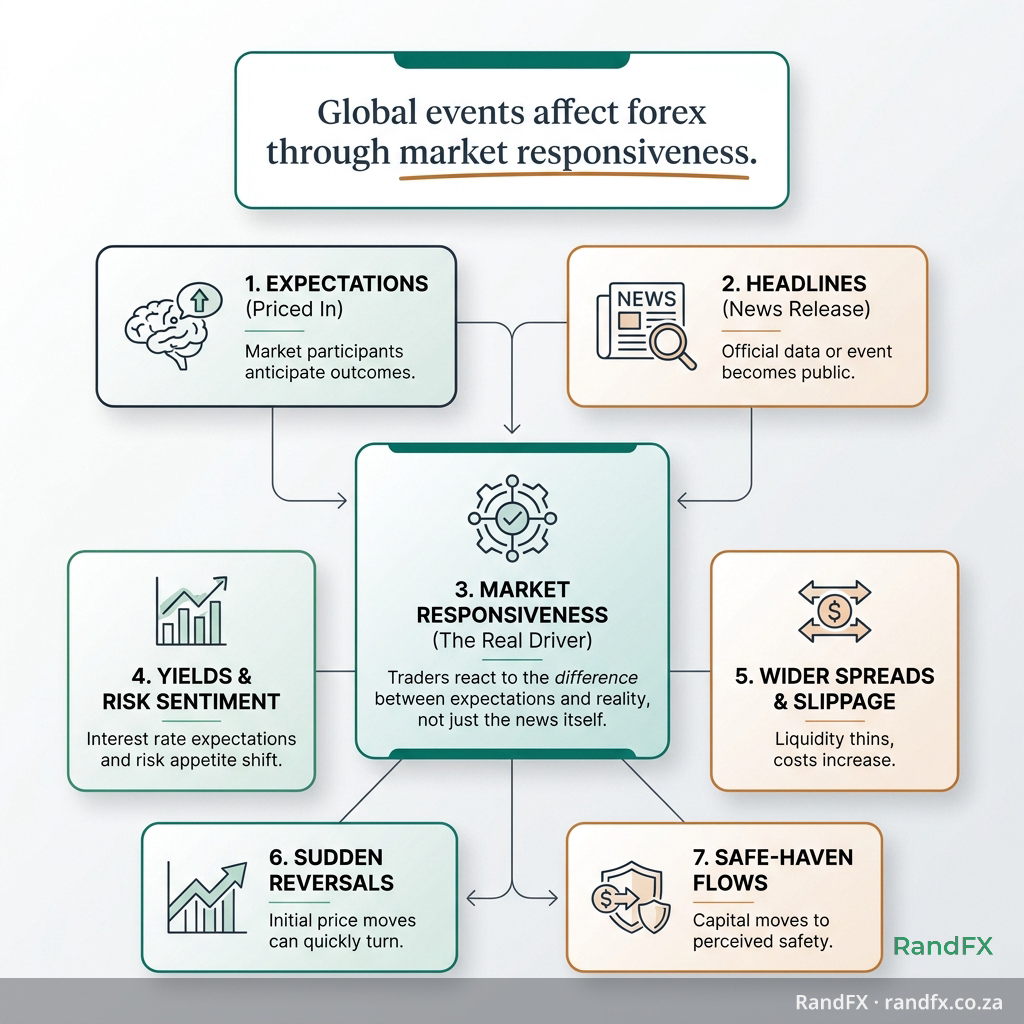
This is why how the market reacts matters more than the event’s name.
Watch yields, risk feelings, and linked currencies before you think the first price jump will last.
Forex reactions often show up as bigger spreads, slippage, quick reversals, and shifts in safe-haven flows.
Treat each event like a risk task: check the calendar, guess the reaction, control your risk, and check the trade after the noise calms.
Quick Answer: Global events shape forex trends by shifting trader expectations on interest rates, growth, and risk sentiment—not just headline data. Trading well means having a clear, disciplined plan with set risk limits, watching related currencies like USD/ZAR, and managing your trades carefully during volatile moments. For instance, tracking the FOMC decisions in South African time helps control risk with unpredictable pairs.
How do global events affect forex market trends?
Global events change forex prices based on what traders expect, not just the headlines.
Before trading on an event, decide if you will trade the first move, wait for more proof, or stay out if spreads and slippage are too high.
- Set your decision: Write down the event, pair, entry rules, fail point, max risk, and when not to trade.
- Make scenarios: Think about how rate expectations, growth, and risk mood may change. A cautious Fed could help the dollar with higher yields. Faster rate cuts might weaken it. These reactions are not certain.
- Control execution: Keep analysis, position, and execution risks separate.
Success means having a written plan before you check the economic calendar. Know if USD/ZAR risk is okay when the rand gets more volatile.
Gather inputs for a solid event plan
Use South African time. Check details on a trusted calendar and with your broker.
| Input | Check | South African example |
|---|---|---|
| Event | FOMC, CPI, NFP, GDP, rate decision, or shock | FOMC affecting USD/ZAR |
| Time | Release, daylight-saving changes, press conference | Confirm New York time in SAST |
| Figures | Forecast, previous result, components | Compare US CPI readings |
| Pairs | Direct and linked exposure | EUR/USD, USD/ZAR, gold |
| ZAR exposure | Risk mood, commodities, local funding | Reduce exposure if USD/ZAR jumps up |
| Conditions | News spreads, slippage, margin, order rules | Check before CPI |
| Account | Correlation, margin, total risk | Combine dollar exposure |
| Broker | FSCA status, funding, withdrawals, execution | Compare brokers |
Keep risk at 0.5%–2% per trade. Lower size when volatility grows.
Get ready for planned events like FOMC, ECB, BoE, CPI, jobs, and GDP, but expect uncertain reactions.
If there is geopolitical trouble, emergency policy, sanctions, or attacks on shipping, do not force trades. Watch liquidity, pause automation, and wait for spreads to get normal.
For automated systems, leave out news times in backtests. Test with wider spreads and slippage. Check VPS connection. Record forecasts, results, spreads, fills, and exits.
Look at the news trading guide and broker reviews before the next event.
Build a step-by-step global-event trading plan
Begin with the event itself, not a trading idea.
Write down the release time in South African time, affected currencies, forecast, last result, and key policy question.
Use the economic indicators guide (source not independently verified) to tell apart effects on rates, growth, and risk flows.
- Rank the forex impact. Start with the currency that is most affected. Then check USD/ZAR, EUR/USD, GBP/USD, and gold. Treat this as a chance map, not a sure outcome. Your result is a ranked watchlist.
| Event category | Usual effect | Pairs to watch | ZAR note | Planning question |
|---|---|---|---|---|
| Central-bank rate decision | Rate hopes and yields | USD pairs, EUR/USD, GBP/USD | Risk mood can move USD/ZAR | Will guidance change rates? |
| Inflation report | Policy changes | USD pairs, EUR/USD | Higher yields may press ZAR | Is inflation above forecast? |
| Employment report | Growth and rate hopes | USD pairs, USD/ZAR | Dollar may get stronger | Do jobs and wages back headline? |
| Election or fiscal news | Confidence and money flows | GBP pairs, EUR pairs, USD/ZAR | Local and global risk overlap | Does policy affect funding trust? |
| Geopolitical shock | Safe-haven moves | USD/JPY, USD/CHF, USD/ZAR | Emerging currencies may drop | Is shock short or long term? |
| Commodity shock | Trade terms and inflation | USD/CAD, AUD/USD, USD/ZAR | Commodity links may soften pressure | Does move help or hurt South Africa? |
A surprise in central bank news usually needs more prep than smaller news.
- Write three scenarios. Define a main case, a stronger-than-expected case, and a weaker-than-expected case. Add a no-trade rule for conflicting data, big spreads, or unclear prices. Know when each allows action.
- Set trade rules before the release. Write entry triggers, fail points, max spread, and how big your position is. Keep analysis risk, position risk, and execution risk separate. Use
risk_amount = balance × risk%and size based on stop distance and pip value. Keep your event risk between 0.5% and 2% using the risk management framework.
- Control execution. Don’t follow the first large move. Check spread, slippage, and fill quality. Automated systems should pause, widen filters, and stay off until backtests and live VPS setups confirm it’s safe to trade news.
- Verify the result. Record forecast, release, entry, fills, spreads, slippage, exit, and which scenario played out. Compare your plan with live results. Find if failure was from analysis, size, or execution. A full plan tells you when to trade, wait, or stay out.
What can go wrong when markets react to global events?
Even if your forecast is right, your trade can still go wrong.
Global events bring analysis risk, position risk, and execution risk. Check each one.
- Check release details first. Confirm the South African release time, involved pairs, forecast, last figure, and spread. Don’t enter right before CPI, FOMC decisions, or jobs reports: prices can gap before your order fills. Success: you know when liquidity may change and if you should trade.
- Watch how the market reacts. A stronger report might not help its currency if traders expected an even stronger result or if it barely changes rate outlooks. Compare price, yields, and policy views. Don’t trust the first spike alone. Success: signals back your plan or you stay out.
- Check fills after trading. Record quoted and actual spreads, requested and filled prices, missed orders, and stop execution. Bigger spreads and slippage can change a planned 1% risk into a bigger loss, especially in USD/ZAR with thin liquidity and quick reprices.
Use platform logs and broker terms before judging a trade.
South African traders should use FSCA-approved brokers and check spread stability, order fills, margin rules, and funding.
Our forex broker comparison (source not independently verified) is a good place to start.
Find the cause of failure before changing strategy
| Problem | Cause | Fix | Rule to add |
|---|---|---|---|
| Spreads got wider than expected | Liquidity dropped | Don’t add to trade | Record max spread |
| Stop hit beyond plan | Slippage or gap | Recalculate risk | Size for slippage |
| Position too big | Normal sizing ignored event risk | Cut size | Cut size before events |
| USD/ZAR impacts many trades | ZAR exposures overlap | Close weakest trade | Set total currency risk |
| Automated trade differs from backtest | Market or execution changed | Pause system | Test live news conditions |
| No fail point set | Emotion made entry | Exit or stay out | Define fail point first |
If spreads, volatility, or correlations beat past ranges, pause automated trades instead of forcing them.
Success means you know if failure is from analysis, size, execution, or broker, before switching strategy.
How to verify your event-trading process before the next release
Imagine the next release comes at 14:30 South African time.
Before you place an order, know the event, your fail point, max loss, and what stops you from trading.
- Run through a readiness checklist. For each step you complete, give yourself one point:
- Know the event: release time, forecast, last result, currency, and policy question.
- Define your scenarios: when to go long, short, delay entry, or skip the trade.
- Calculate account risk in rands, adjust size, and check margin.
- Track execution details like usual spread, expected volatility, trading hours, and broker limits.
- Prepare to log post-trade info: release, fills, slippage, exit, and decision quality.
Only trade after you’ve checked every box.
Missing a score is not just a formality; it shows part of your plan is guesswork.
- Check your broker before things speed up. Review variable spreads, stop-out rules, minimum trade distances, if they offer guaranteed stops, execution policy, and news trading limits. South African traders also check ZAR funding, withdrawal timing, FSCA rules, and if USD/ZAR fits your risk.
Record usual spreads before the event. Compare them with spreads during similar events.
This helps measure broker market responsiveness instead of trusting ads.
If execution needs more checks, use our Compare forex brokers tool (source not independently verified) to see real trading conditions.
- Run through the event on paper once. Pick an upcoming event like FOMC, CPI, or jobs release. Finish your forecast, three scenarios, size calculation, entry delay, stop loss, and cancellation rule without trading live.
If automated, backtest the event first.
Then check VPS link, time zone, spread filter, news pause, and rejected orders.
Keep live news trading off until all tests pass.
Your plan is ready when another trader can follow it and make the same call.
Do the checklist again after the release, then change one rule at a time.
Is forex trading still profitable in 2026?
Forex trading can be potentially profitable in 2026 but generally requires disciplined risk management and a well-defined trading plan. Traders must monitor global events that shift expectations on interest rates, growth, and risk sentiment, and control execution risks like spread widening and slippage. Success depends on setting entry conditions, risk limits, and waiting for confirmation rather than reacting impulsively.
What are the projected global trade trends for 2026?
Global trade trends in 2026 will continue to be influenced by geopolitical risks, interest rate policies, and economic growth expectations. Traders should assess how these factors affect currency pairs like USD/ZAR, EUR/USD, and GBP/USD. The market’s reaction will be based on shifting trader sentiment and risk appetite rather than headline data alone.
What news affects forex the most?
Forex is most affected by news that influences interest rate expectations, inflation data, central bank decisions like FOMC meetings, and geopolitical risks. These events shift trader sentiment and cause volatility through widening spreads, slippage, and sudden price reversals. Therefore, timing and market responsiveness to these news releases are critical for effective trading.
Can AI predict forex markets?
The article does not specifically address AI’s ability to predict forex markets, but it emphasizes that forex moves reflect trader expectations and market sentiment rather than fixed outcomes. Reliable trading involves scenario planning and risk management rather than precise prediction, implying AI tools may assist but cannot guarantee accurate forecasts.
What are the current geopolitical issues in 2026?
Current geopolitical issues in 2026 act as key drivers of forex volatility by influencing risk sentiment and global economic stability. Specific details are not provided, but traders must monitor geopolitical risks closely as they can trigger sudden market shifts and affect currency valuations alongside interest rate and growth news.
Turn Global Events Into a Repeatable Process
Global events are not invitations to predict every price move; they are prompts to control exposure before volatility arrives.
The most valuable habit is a repeatable process: calendar check, scenario planning, defined risk, execution, and post-trade verification.
A Sunday review that flags an FOMC decision, US inflation data, and geopolitical risk gives a Johannesburg trader time to question the forex impact rather than chase the first candle.
It also improves market responsiveness by separating genuine repricing from a temporary spike.
Today, open next week’s economic calendar and write one trade plan with entry conditions, maximum loss, no-trade trigger, and review time. Record the result after the release, including whether your risk stayed within plan; that evidence will shape your next decision.