

Broker risk disclosures from 2026 show that 70% to 85% of retail CFD accounts lose money.
This number remains consistent, despite seemingly sound strategies.
The entry signal is usually not the problem.
The issue is everything around it: position sizing, exit rules, and if the idea was tested against real costs like spreads and slippage.
If you search for the best forex trading strategy development services, you will find many similar promises.
Courses, signal groups, bots, and consultants all claim to provide the same advantage.
Few explain how they researched and tested the strategy or what happens when market conditions change.
This is the key issue to understand.
When you pay someone to develop a strategy, you lose control over risk decisions that you still need to manage.
So, evaluate providers based on the entire process, not just their sales pitch.
This includes the quality of research, test design, risk controls, and how the strategy is implemented.
And whether the strategy works under the actual broker conditions you use.
Quick Answer: The best forex trading strategy development services focus on a structured process that transforms trading objectives into defined rules for entry, exit, and risk management. As global OTC FX turnover hits $9.6 trillion daily, these services are essential for lowering the high failure rate of 70-85% among retail CFD accounts. Prioritize providers that emphasize research quality, rigorous testing, and risk controls to ensure effective strategy implementation.
What Are the Best Forex Trading Strategy Development Services?
If you ask ten traders what strategy development is, you’ll get ten different answers.
Most will refer to specific signals, such as moving-average crossovers, breakout levels, or common chart patterns.
But that is not the meaning of strategy development.
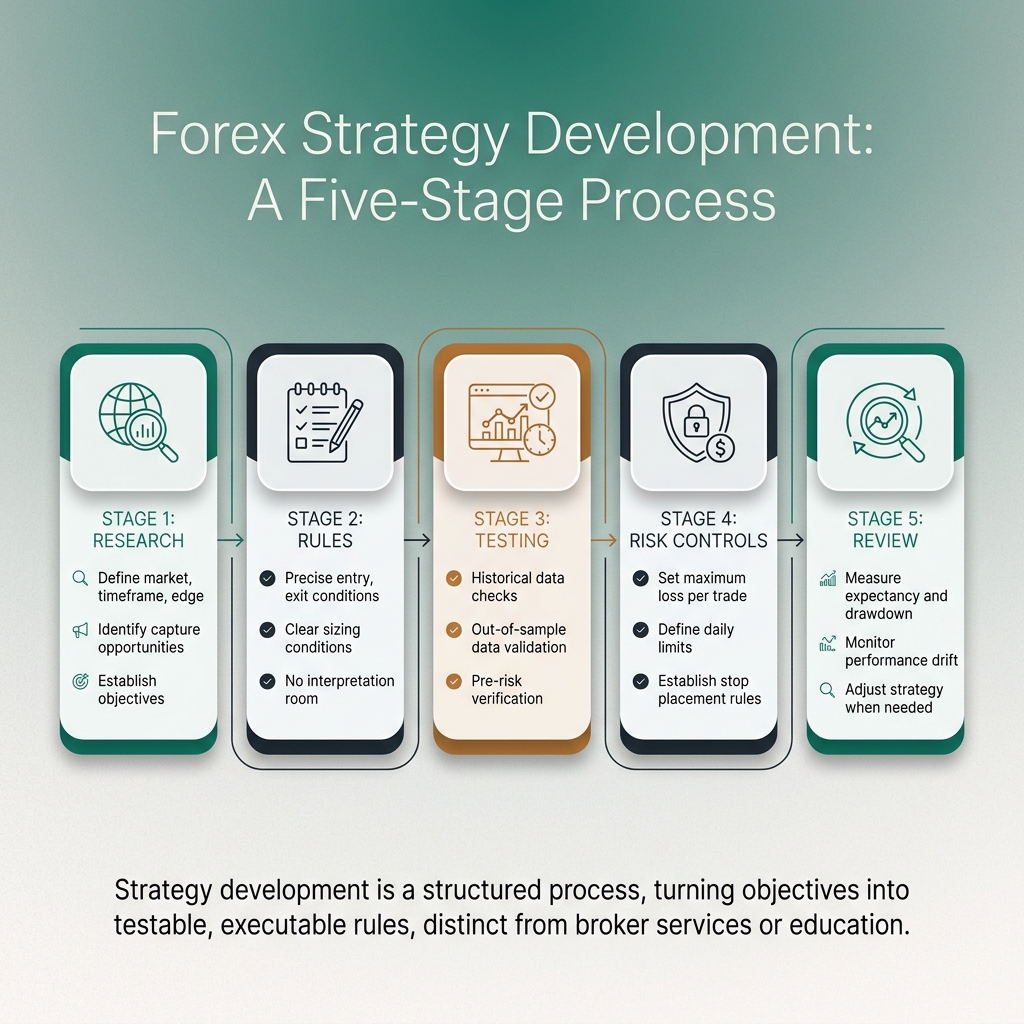
Strategy development is a process.
It takes a trading goal and makes specific rules you can test, apply, and evaluate.
The result isn’t a buy or sell alert. It’s a documented method with clear entries, exits, position sizes, and conditions for failure.
This process has five linked stages:
- Research: Defining the market, timeframe, and edge you’re trying to capture.
- Rules: Writing precise entry, exit, and sizing conditions that leave no room for interpretation.
- Testing: Checking those rules against historical and out-of-sample data before risking money.
- Risk controls: Setting maximum loss per trade, daily limits, and stop placement rules.
- Review: Measuring expectancy and drawdown, then adjusting when performance drifts.
Notice what is missing from that list.
Broker selection, trading education, and account management are alongside strategy development — they are not part of it.
A broker decides your costs and fills.
An educator builds your understanding.
An account manager runs someone else’s money.
Mixing these layers causes real confusion.
Traders blame a strategy for what is actually a spread problem, or assume a course alone will repair a flawed system.
Separating them makes every decision cleaner.
The best forex trading strategy development services sell that process, not a promise.
Judge them by how rigorously they research, test, and control risk — never by the returns they advertise.
Why Strategy Development Services Matter to Individual Forex Traders
It's 8:40 on a Tuesday morning, and the chart is loaded with an R.
At that moment, many individual Forex traders see the price clearly but find it hard to decide what to do next.
Strategy development services matter because they convert this uncertainty into a repeatable process. They create a plan that links market context to specific actions.
Instead of depending on impulses or making decisions from scratch each trade, a solid strategy outlines when to enter, when to exit, and how to manage risk as parts of one connected system.
It’s like having a checklist for similar situations. Each trade needs attention, but the process doesn’t begin anew each time.
This consistency helps close the gap between what you mean to do and what you do when emotions take over.
Equally important, strategy development focuses on clear rules and trade management.
When your approach is written, tested, and refined with intentional feedback, you spend less energy guessing and more time executing—so your decisions can stay aligned even when conditions shift.
How Forex Trading Strategy Development Works
You won’t get a folder labeled ‘finished edge.’ Real development is a series of decisions. Each stage makes things clearer and lessens the chances for failure.
If you skip a step, the weaknesses will appear later, usually when you are risking money.
It starts with the trader, not the chart.
Before you write a rule, clarify your screen time, the trading session, and the maximum loss per position you can handle without stress.
A scalper who trades one-minute charts and a swing trader who holds positions for a week require different frameworks.
Timeframe, market, and risk limits come before any indicator.
Research follows, turning ideas into executable logic. “Buy pullbacks in an uptrend” is a concept; a workable ruleset specifies triggers and mechanics: for example, when the 34 EMA sits above the 50 EMA on a four-hour chart, enter on the first pullback that closes above the shorter average; place the stop 1.5x ATR below entry; risk 1% of the account.
Entry, exit, size, and risk are defined before any trade happens.
Testing then checks whether those rules hold up against real conditions.
Historical backtesting can flatter performance, so you also need out-of-sample testing on untouched periods, then paper trading, then a small live trial.
The goal isn’t a perfect equity curve—it’s evidence the “edge” doesn’t vanish when conditions shift.
Implementation is where strategy meets execution details: order types, position-size calculations, and your trade journal—plus broker conditions.
Spreads, execution speed, and vary, so even the most thoroughly tested ruleset can underperform on an unsuitable account.
Reviewing broker options alongside your strategy—exactly what our Finally, review.
Markets change, so scheduled check-ins—monthly performance review, rule adjustments when evidence supports it, and a firm line against changing rules mid-drawdown—protect discipline.
Examples, Provider Differences, and Misconceptions
Two traders can buy the same course and walk away with very different tools.
One builds a rules-based trend approach around a single session — London open, say — with fixed entries, exits, and position size.
The other already trades consistently and needs portfolio-level risk limits instead.
Same provider, two briefs.
That gap is a useful test when you’re comparing services.
For the part-time trader, a defined session and a rules-based trend approach solve the real problem: decision fatigue.
The benefit isn’t just “more structure,” it’s fewer hours watching, clearer triggers, and fewer judgment calls made on no sleep.
The course that helps here is the one that reduces choices under time pressure.
For the advanced trader, another indicator adds nothing.
What helps is exposure limits across pairs, correlation checks before stacking positions, and a drawdown rule that cuts size once it’s hit.
In other words, the missing piece isn’t signal quantity; it’s portfolio control under stress.
Backtested results sit between both conversations.
They’re evidence worth examining—how data was handled, how long the sample runs, whether costs are included—never proof of what happens next.
A common misconception is treating a backtest as an outcome forecast, instead of a window into what was tested.
Responsible Evaluation vs Common Shortcuts
| Do | Do not |
|---|---|
| Check how data was handled, how long the sample runs, and whether costs are included. | Treat backtested results as proof of what happens next. |
How to Assess Services, Limits, and Your Next Decision
You’ve narrowed it to three providers.
Each promises a tested system.
The real decision rests on what you can verify before paying — and what you’ll still own afterwards.
Start by asking what actually lands in your inbox.
The best forex trading strategy development services provide tangible artifacts, not just promises.
- Documented rules: entry, exit, and position sizing written clearly enough to hand to another trader.
- Testing evidence: sample period, data source, and whether spreads and commissions were included.
- Education and support: what happens if the strategy underperforms for three straight months.
- Code or platform files: something you can inspect yourself, not just a signal feed.
Then examine how the provider handles data and conflicts of interest.
Do they disclose whether they also run a brokerage or earn referral fees? A provider paid per trade has a very different incentive from one paid per course.
Match the service to your reality — experience, budget, screen time, and how you handle a losing streak.
A part-time trader with two hours a week needs a swing approach holding positions for three to ten days, not a scalping system that demands constant attention.
Broker conditions decide whether a strategy even works the way it was tested.
Spreads, execution quality, regulation, and available instruments all shift your results, and in South Africa the regulator determines what you can access at all.
Our Finally, accept the limits.
No service removes market risk, tax obligations, or the need for your own oversight.
Good assessment replaces hope with evidence — and that’s a decision you can defend.
Who is the best forex expert advisor (EA) in 2026?
The best forex expert advisor (EA) in 2026 has not been clearly defined, as the market is flooded with various EAs claiming superiority. When choosing an EA, traders should focus on the quality of research, testing, and risk management, rather than just marketing promises. Look for EAs that provide documented results and transparent strategies to evaluate their effectiveness.
What is the best trading strategy in 2026?
The best trading strategy in 2026 is one that transforms trading objectives into clearly defined rules for entry, exit, and risk management. A structured approach that incorporates thorough research and testing is essential, especially considering that 70-85% of retail CFD accounts tend to lose money. Focus on strategies that adapt well to changing market conditions and are backed by concrete evidence.
Who is the best forex trader in the world in 2026?
The title of the best forex trader in the world in 2026 is subjective and depends on individual performance metrics, risk management, and overall strategy effectiveness. Often, successful traders develop their systems through a rigorous process of research and testing. It’s important to identify traders who consistently achieve strong returns while maintaining manageable risk levels.
How much can you make with $10,000 in forex per day?
Earnings from $10,000 in forex trading per day can vary widely based on several factors, including, risk management, and trading strategy. The forex market has high volatility and many variables that can affect profits; thus, aiming to make a consistent and realistic return relative to risk is crucial. Understanding how to manage your position sizes can your trading results.
What is the 3-5-7 rule in forex trading?
The 3-5-7 rule in forex trading refers to a specific guideline for position sizing and trade execution across different timeframes or market conditions. This rule emphasizes having established parameters for entering and exiting trades, aligning risk with trading objectives. It’s essential to adapt this framework within a well-defined strategy that incorporates thorough research and testing.
Turning Strategy Research Into a Trading Decision
What separates the best forex trading strategy development services from polished documentation is everything around the rules: honest out-of-sample testing, position sizing, and a plan for when markets stop behaving.
A strategy that only works under ideal conditions is a liability wearing a spreadsheet.
Think back to the walk-forward example.
A setup that looked brilliant on historical data failed once real spreads, slippage, and news volatility entered the picture.
That gap is where most retail accounts quietly erode.
Ask one uncomfortable question first: how does your current strategy perform on data it has never seen? If you want a structured starting point, our strategy development work pairs test design with broker-condition checks, and our broker comparison shows where execution costs will quietly reshape your results.