
Udemy lists about 719 forex trading courses. More than 2.5 million learners are enrolled in these courses.
And that’s one platform.
Including broker academies, live trading rooms, and free video playlists, finding a course gets easier.
However, judging a course can be difficult.
This decision is toughest for individual traders.
You don’t get a syllabus, a risk limit, or an instructor to notice when you abandon your plan.
Courses often sell the idea of certainty.
Recent research shows that the forex market trades about $7 trillion each day. No course can make that predictable.
The best forex course for you depends on how well it fits your needs.
Factors that matter more than star ratings include your current skill level, your available time, and how the course addresses risk and trading psychology.
Traders who skip this filter often pay twice: once when buying the course and again in trading losses.
Quick Answer: We find the best forex trading courses for individual traders teach decision-making rather than just technical jargon, focusing primarily on risk management and trading psychology. With over 250,000 courses available on Udemy and 80 million learners, it’s crucial to select a course that matches your skill level and commitment instead of purely opting for the best marketing. Prioritize foundational content to navigate the $7 trillion daily forex market effectively.
What are the best forex trading courses for individual traders?
Udemy listed 719 forex courses in 2026. These courses had 2,575,268 learners enrolled.
This large number makes choosing harder, which is why many traders buy marketing, not education.
A forex trading course teaches you how currency markets operate.
It explains how currency pairs are quoted, how charts and trends work, how drawdown affects your account, and how to create a pressure-tested plan.
It teaches you a process.
It does not provide specific entry points.
The best forex trading courses for individual traders have one thing in common: they teach you to think critically, not just copy others.
Education cannot guarantee returns, and no course turns a beginner into a profitable trader on schedule.
Industry data shows that the forex market trades about $7 trillion a day, mostly from banks and institutions, not retail accounts.
A good course prepares you for this reality rather than claiming to offer a shortcut.
A Checklist for Judging a Course Before You Pay
| Evaluation criterion | What good looks like | Warning sign | Why it matters |
|---|---|---|---|
| Market fundamentals | Explains currency pairs, the 24-hour over-the-counter market, and who moves price | Jumps straight to entries with no market context | You cannot judge a setup without knowing what drives the pair |
| Technical analysis | Teaches chart reading, trends, and one repeatable framework | Lists twenty indicators with no logic linking them | Indicator overload replaces decisions with guesswork |
| Risk management | Covers position sizing, stop placement, and drawdown limits with worked examples |
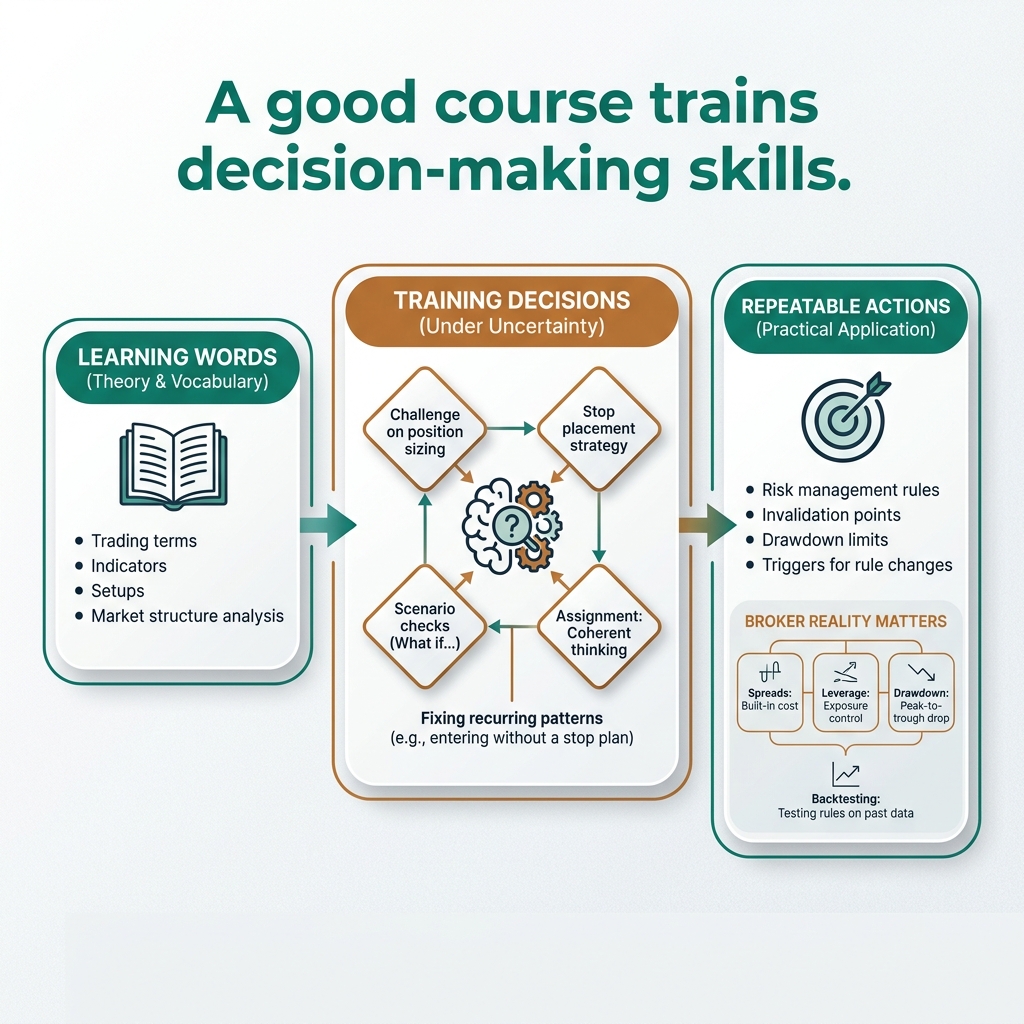
A good course builds decision-making skills, not just trading vocabulary
Have you noticed how some traders can use terms and indicators but struggle when prices change quickly? This shows the difference between learning terminology and practicing decision-making.
A good course helps you decide your next move when things are uncertain, not just explain what happened later.
A solid forex education helps us turn analysis into repeatable actions—like deciding how much to risk, identifying invalidation points, and knowing when to limit our losses. Spreads matter because they’re the built-in cost between bid and ask; determines how much exposure you control per rand; drawdown is the peak-to-trough drop in your account; and backtesting means running your rules on past data to see whether they still hold up when conditions change.
A practical course avoids just “strategy lectures.” It gives assignments that show if your thinking is clear, especially before you act.
One busy professional we helped could explain market structure, but their journal showed they repeatedly entered trades without a stop plan and increased risk after losses.
The solution wasn’t to learn more terms.
It was about understanding the key decisions to make right before each trade.
The focus needs to be clear.
You should be challenged on position sizing, stop placement, and scenario checks like “what would you do if…”.
You should also learn about drawdown limits and rule change triggers. Understand that margin is a real risk source, not just about confidence.
Finally, the broker you choose matters. Spreads, commissions, and execution differ by broker and impact whether your rules hold up.
Broker due diligence belongs here too: check regulation for your jurisdiction, confirm deposit/withdrawal costs, keep trade records for reporting, and confirm any tax obligations with a qualified local adviser.
For broker comparisons, use Compare forex brokers.
A course earns trust when it trains judgment you can apply on real days, not just in quiz questions.
One trader starts with chart patterns and ends up rebuilding the basics
A trader we know spent his first month memorising head-and-shoulders patterns.
Six months later, he was back at square one, working out what a spread actually costs him.
That loop is common, and it is avoidable.
The path runs from market foundations to a written plan, and each stage earns the next.
Foundations come first. Currency pairs, who moves price, why the market trades around the clock, and what a pip, spread, and lot size mean in rand terms.
Industry data suggests that if you skip this, every later lesson sits on sand.
Then data interpretation. An economic calendar tells you when inflation, employment, and interest-rate news lands.
Those releases move the rand quickly, so knowing the schedule matters more than predicting the number.
Analysis splits into three jobs. Technical analysis reads charts and market structure — trends, levels, and patterns such as those covered in ICT, Smart Money Concepts, and Elliott Wave material.
Fundamental analysis asks whether an economy’s direction supports its currency.
Price action is the practical layer: reading what buyers and sellers are doing right now.
None of the three decides alone.
A decision combines them.
News due in ten minutes, price sitting at resistance, and a position sized so a loss costs 1% of your account — that is a plan talking, not a pattern.
Practice comes next.
Demo trading builds familiarity without pressure, and a trade journal records entry, exit, reason, and result.
Backtesting has limits: old prices contain no slippage, no spread widening, and no hesitation.
Following a method means understanding why a setup works.
Copying a signal means you cannot adjust when it stops working.
That is where the real course begins — not with a pattern, but with a written plan you can review and refine.
The most expensive course is not always the one with the highest price
A R770 annual membership and a $99.99 one-off course are examples of different pricing structures.
Yet the cheaper option — the Complete Foundation Forex Trading Course on Udemy (2026), with lifetime access and a completion certificate — often gives more usable structure than a rolling subscription that stops the moment you cancel.
Price signals incentives, not teaching quality.
Subscription platforms rely on recurring revenue, so they’re built around retention.
One-off sellers need a persuasive sales page, which is a different skill from designing a syllabus.
Neither model guarantees you learn.
What you’re buying is access to a format, and that format fits some people better than others.
Matching course formats to what you need
| Course type | Best for | Typical strengths | Common limitations | Questions to ask |
|---|---|---|---|---|
| Free introductory course | Testing your interest before spending | Low risk, terminology and market basics, self-paced | No accountability, no feedback, rarely reaches risk work | Does it move beyond definitions into decisions? |
| Self-paced paid course | Disciplined learners who study alone | Lifetime access, structured modules, downloadable resources, certificate | No live trading room, no instructor feedback on your trades | Are there worked examples, or just slides? |
| Instructor-led cohort | People who need deadlines and feedback | Live sessions, questions answered, peer pressure | Fixed schedule, higher price, replays not always included | What if I miss a week? |
| University or professional program | Certification-focused learners | Structured assessment, recognised credentials | Slower pace, theory-heavy, light on execution | Does it teach position sizing in practice? |
| Mentorship or community program | Traders needing ongoing market contact | Real-time ideas, webinars, community access | The Home Trader Club (2026) offers no refunds and no lifetime access, so cost compounds | Is it structured, or mostly informal talk? |
The right course depends on the trader’s starting point, not a universal ranking
Rankings sell clicks.
They rarely tell you what to enrol in.
The same course can rescue a complete beginner yet waste an experienced chartist’s time—not because the material is weak, but because the starting point is wrong.
Four variables decide fit: what you already know, how many hours a week you can genuinely study, whether you want live contact or self-paced video, and how much screen time you will give to practice.
Starting from zero: pick structured modules that move from market mechanics to charts, then to risk.
Udemy’s Complete Foundation Forex Trading Course 2026 covers 8.5 hours in that order for $99.99, with lifetime access.
Returning with gaps: test the curriculum against what tripped you up.
If position sizing and drawdown were the problem, a course heavy on chart patterns will not fix it.
Running a method without a risk plan: look for worked drawdown examples, journaling templates, and review routines rather than another indicator library.
Then screen claims: publishable syllabus, named instructors, and risk management as a core module beat guarantees and unsupported win-rate talk.
Education also has a ceiling.
It cannot fix an inability to hold a rule under pressure, and it cannot answer your tax questions; regulatory and tax matters need a qualified local adviser.
Screen the shortlist against the table below before any money changes hands.
Pre-enrollment checklist
| Question | Evidence to look for | Acceptable answer | Red flag |
|---|---|---|---|
| Is the curriculum complete? | Published module list covering market mechanics, charting, risk, and psychology | Risk taught before live trading, with worked examples | Risk appears as a single slide or is called “common sense” |
| Who teaches the material? | Instructor bio with verifiable trading or teaching history | Named instructor, credentials you can check independently | Anonymous “professional traders” or stock-photo profiles |
| Is risk management central? | Position sizing, stop placement, and drawdown limits as their own module | Numeric examples showing what a losing streak costs | framed purely as opportunity, never as exposure |
| How is practice assessed? | Quizzes, case exercises, or a marked trading plan | Feedback on decisions, not just multiple-choice recall | No assessment at all, or completion awarded for watching |
| What support is included? | Live sessions, trading room, or a moderated forum with response times | Support that matches your schedule and time zone | “Unlimited support” with no stated channel or hours |
| Are fees and refund terms clear? | Total cost stated up front, refund window in writing | Refund period you can test the course within | Auto-renewal, no refunds, or pressure to upgrade mid-course |
| Are claims independently supportable? | Realistic statements about time to learn and expected outcomes | Months of study acknowledged, no profit promises | Guaranteed returns, “replace your salary” framing |
The screen takes about twenty minutes per provider, and you should check the refund window against your own schedule before you pay, since the cheapest course you never finish costs more than the one you complete.
What is the best course to learn forex trading?
The best course to learn forex trading is one that emphasizes decision-making, risk management, and trading psychology. With over 719 courses available on Udemy, the right choice depends on your skill level, time commitment, and how well the course aligns with your learning needs.
Can I learn forex by myself?
Absolutely, we can learn forex by ourselves, but it takes a structured approach. Many successful traders start with foundational knowledge and gradually build their skills through self-study, practice, and analyzing market behavior.
Can you make $100 a day on forex?
While some traders aim to make $100 a day on forex, achieving this consistently depends on various factors including trading strategy, risk management, and market conditions. Consistently achieving this requires discipline, a solid trading plan, and an understanding of and market movements.
What is the 3-5-7 rule in forex?
The 3-5-7 rule is not specifically defined in the content provided. However, successful trading generally involves techniques that prioritize risk management and gradual skill development, helping traders make informed decisions under market uncertainty.
Think of a course as a tool; it works best when it’s the right fit for the job at hand.
The trader who studied chart patterns before market structure didn’t waste months because the course was bad—he wasted them because the sequence was wrong for his starting point.
That’s why the best forex trading courses for individual traders are rarely the highest-rated on a platform.
Price and enrolment counts show what the market likes, not what you’re missing.
Before enrolling, write down your current gap: risk control, journaling, or reading price.
Then choose the course that targets exactly that weakness.
If a broker academy is on your shortlist, our broker comparison shows the training and execution conditions attached to each account.