

Most traders who blow their first account do not fail because they picked the wrong indicator.
They fail at the same handful of decision gates that separate professionals from the crowd.
Ask any of the top forex traders how their trader journey started and you rarely hear a story about a winning strategy.
You hear about a small account, a fixed risk limit, and months on a demo platform learning how a losing trade actually feels.
That is the part nobody markets. Beginner forex trading is a sequence of verified behaviours, not a collection of inspiring profiles — choose a regulated broker, test one process on demo, risk a set percentage per trade, journal every entry, and scale only when the numbers agree.
We’ll walk you through that sequence step by step.
Each stage ends with a gate to clear before you move to the next one.
Quick Answer: We need a structured approach to beginner forex trading that centers on four critical skills: reading price charts, placing demo orders with stop losses, developing a trading plan, and setting maximum loss thresholds. Before transitioning to a live account, traders should ensure proficiency in these areas to avoid common pitfalls. This disciplined preparation can prevent significant financial losses and enhance trading success.
Beginner forex trading starts with a clear outcome
Most people open their first live trade before they can explain why.
That single habit sinks more accounts than any bad indicator ever will.
The fix isn’t a smarter entry signal.
It’s deciding what you want before money is on the line — the skill you’re building, the routine you’ll repeat, and the result that proves the process worked.
Beginner forex trading becomes more manageable when each stage has a clear task and a measurable completion check.
Traders who last tend to run plain, repeatable routines far longer than newcomers expect, so the trader journey rewards consistency over cleverness, rather than a single well-timed position.
Before you fund a live account, you should be able to do four things without help:
- Read a basic price chart and mark direction, support and resistance.
- Place a demo order with a stop loss and a pre-decided exit.
- Write a one-page plan covering entry, exit and position size.
- State the maximum loss you’ll accept on any single trade.
If any of those four feel shaky, stay on demo.
It costs nothing and exposes exactly the gaps a funded account would turn into real losses.
Set your starting conditions before the market sets them for you
Four numbers and one commitment define your starting line.
- Time: how many hours a week you can realistically review charts and journal results.
- Capital: money you could lose without touching rent, savings or debt repayments.
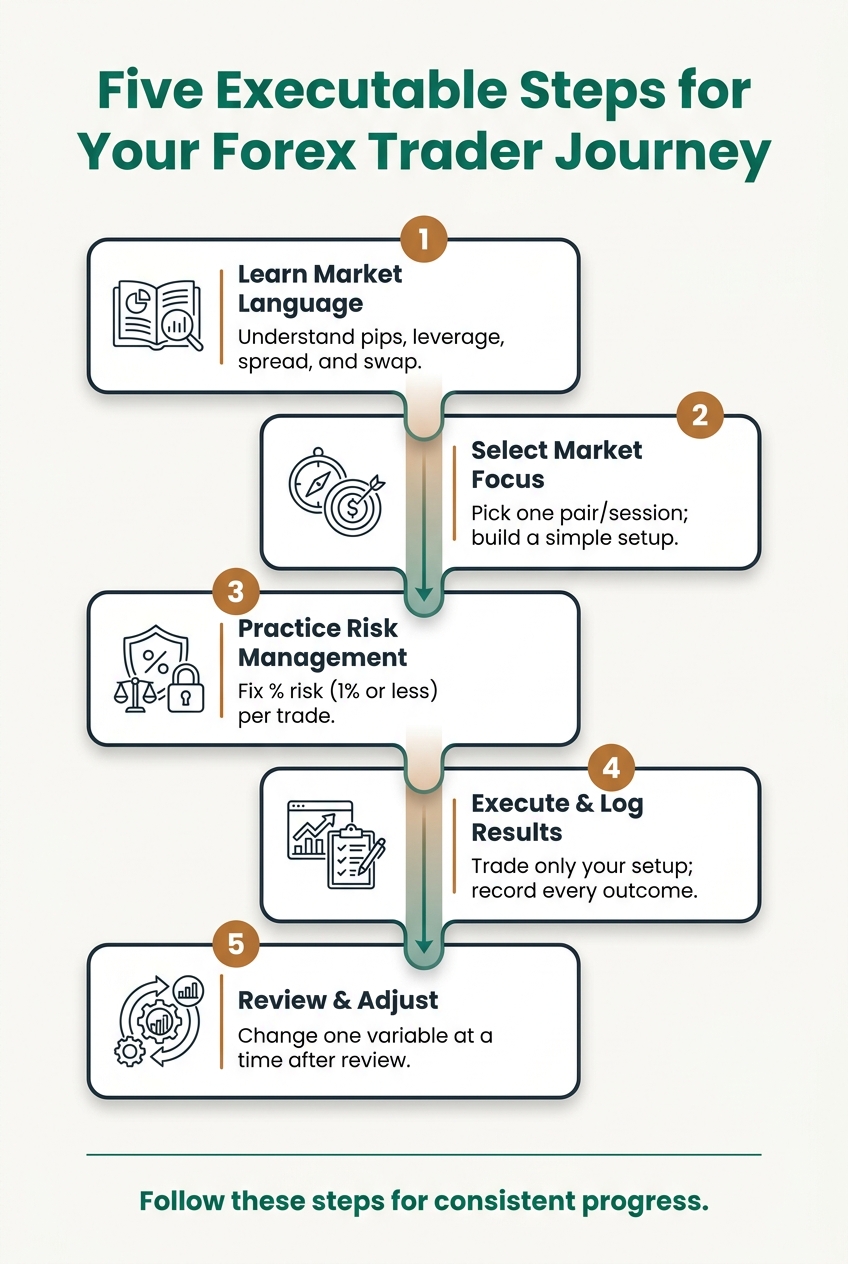
Follow the trader journey in five executable steps
Beginner forex trading rarely fails because of a missing indicator.
It fails because the stages get run out of order, or all at once.
The trader journey only moves forward when each stage closes before the next opens.
Follow five executable steps—each includes a completion check you can verify without anyone else’s opinion.
1.
Learn the market language and how a trade works.
Start with mechanics: what a pip measures, how multiplies both directions, and why spread and swap sit between your entry and your profit.
Chart patterns come later.
Completion check: you can explain a long and short position, margin, and a stop-loss to someone who has never traded.
2.
Select one market focus and build a simple setup.
Pick one pair and one session, then stay there until repetition replaces guesswork.
Write two or three entry conditions and one exit condition onto a single page.
Choosing where to execute that plan matters as much as the plan itself.
Spreads, execution speed and regulation vary widely, and our Compare forex brokers page puts those side by side before you commit capital.
Completion check: your setup fits on one page, and you can name the exact condition that voids it.
3.
Practise risk management before seeking bigger returns.
Research from How to Become a Forex Trader and How Long Does it Take? (www.dukascopy.com) shows that fixing a percentage risk per trade—1% of account value or less—and letting position size fall out of your stop distance rather than your ambition is a sound strategy.
Completion check: you can calculate lot size from stop distance.
4.
Execute only your setup, and log every result.
Place trades only when your entry conditions are met, then follow your exit condition exactly.
Record entry, stop-loss, target, spread/execution details, and what actually happened—then stop if you break your rules.
Completion check: after 10 trades, you can point to at least one recorded trade where the entry was valid and one where the exit triggered exactly as written.
5.
Review, adjust, and repeat the cycle—without skipping stages.
After each review, change one variable at a time (only if your setup is consistently failing).
If you can’t explain the reason for results, you haven’t completed the previous step—go back and verify.
Completion check: you can describe the single reason your last change was made and what evidence would prove it worked.
Troubleshoot the failure points that interrupt progress
A plan rarely collapses all at once.
It catches on one of four predictable points, and each one has a fix you can apply in the same week you spot it.
Treat troubleshooting as a step in the process, not a sign you chose the wrong path.
You are looking for the specific interruption, closing it, and confirming it stayed closed.
- The strategy looks sound but results don’t match. Replay your last twenty trades against your written rules and mark every deviation. Most gaps come from execution drift, not a broken plan. You’ve fixed this when fewer than two deviations appear across the next twenty trades.
- Losses turn into revenge trading or oversized positions. Set a daily loss limit before the session opens. After two consecutive losses, stop for the day. Size every position from a fixed percentage of account equity, never from conviction. Success looks like a full month where no single loss breaks your cap.
- Data or platform information feels unreliable. Log the source and timestamp for every figure you act on. If a price, feed, or news item can’t be traced to a named source, don’t trade it. Confirm anything material against a second source before the order goes in. You’ve closed this gap when nothing in your journal starts with “I think”.
- Broker, tax, or compliance questions stay unresolved. Open admin creates hesitation, and hesitation produces skipped steps. Write out what’s outstanding, then close one item each week. Compare forex brokers when fees, regulation, or withdrawal terms are the blocker. The check is simple: nothing left unanswered for more than seven days.
Each fix above ends with a completion check you can verify with your own records.
That matters more than how the problem felt at the time.
Close the interruption before you refine the strategy.
Beginners who patch these four gaps keep the trader journey moving, and top forex traders treat the same four checks as routine maintenance rather than setbacks.
Verify your progress and choose the next responsible action
Which number matters more after three months of practice: your win rate, or how quickly you can explain a losing week? The second one tells you whether the next step is safe.
Readiness behaves like a driving test.
Nobody passes because they want the licence.
They pass because an examiner watches specific behaviours performed without prompting.
Run a readiness review before you go live
Book a fixed review date and grade four areas: market knowledge, process, risk control, and records.
Grade against written evidence, not memory.
An area with no evidence fails by default, and that is deliberate.
It stops momentum from being mistaken for skill.
| Readiness area | Evidence required | Pass condition | Action if incomplete |
|---|---|---|---|
| Market knowledge | Explain how spread, margin and rollover affect one open position | You can teach it without notes | Return to course material for one week |
| Written trading plan | Entry, exit, stop and target rules for one setup | A stranger reads the rules the same way you do | Write it before the next trade |
| Position-size calculation | Worked example using account size, risk percentage, stop distance | Risk per trade stays at or below your stated limit | Recalculate by hand until it is automatic |
| Journal quality | Twenty consecutive entries including the reason for each decision | Every entry names the reason and the outcome | Add the missing fields, then review weekly |
| Loss-control routine | Daily and weekly loss caps written down |
What are the steps to becoming a professional forex trader?
Becoming a professional forex trader involves a structured approach with five steps: learn market mechanics, master trading psychology, create a trading plan, manage risk effectively, and regularly review and adapt strategies. Focus on trading habits like journaling and maintaining risk limits to enhance your proficiency and avoid common pitfalls.
Can you make $100 dollars a day with forex?
Yes, making $100 a day with forex is possible, but it greatly depends on your trading strategy, risk management, and capital. Successful traders often start small, understand market movements, and commit to disciplined trading practices.
What is the best way for a beginner to learn forex trading?
The best way for beginners to learn forex trading is through a structured combination of concepts, practice, and review. Start by learning the market’s mechanics, use a demo account to simulate trades, and regularly journal your trading experiences for self-assessment and improvement.
Can forex be self-taught?
Yes, forex can be self-taught, as many traders develop their skills independently. However, it’s crucial to follow a systematic approach, focusing on learning the fundamentals, practicing consistently on demo accounts, and reviewing your trades to refine your strategies.
Who is the top 1 forex trader?
The title of the top forex trader can vary, but George Soros is famously known for his monumental trade against the British Pound in 1992. His ability to anticipate market movements and execute large trades has solidified his reputation as one of the most successful traders in history.
Close the Gate Before You Open the Next Trade
Every gate in this journey rewards the same habit: deciding your risk before the market decides it for you.
The five steps matter less than the order you complete them in, because skipping one checkpoint sends you back to the start.
Think about the trader who doubled their position size after two losses. That single breach, not a bad indicator, is where most beginner forex trading accounts quietly end.
Top forex traders simply repeat boring decisions until the data proves they work.
Pick one gate this week: log twenty trades with fixed risk, then review the numbers honestly.
When you’re ready to test a live account, our broker comparison helps you weigh spreads, regulation, and platform fit before committing capital.