
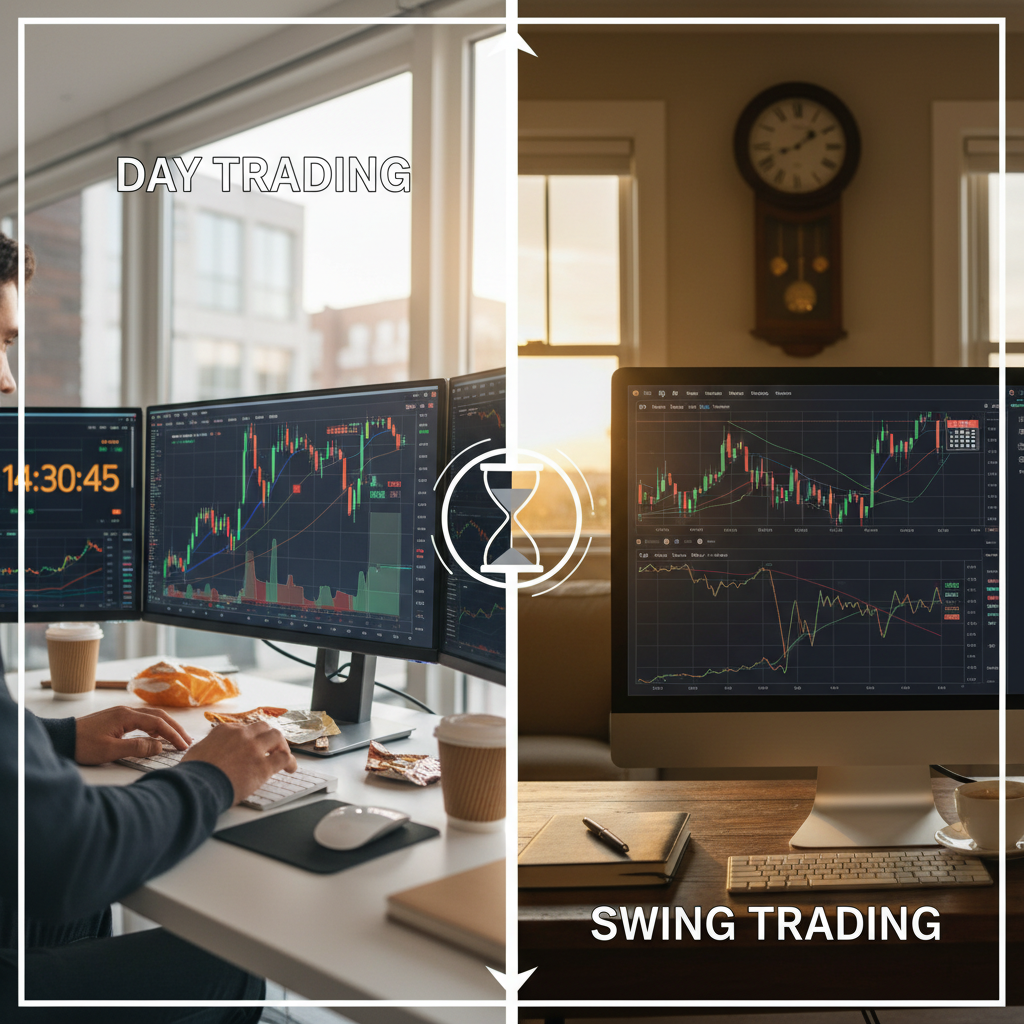
You log into your platform, charts flashing, and feel pulled between two promises: rapid gains if you scalp tiny moves, or steadier profits by holding through a multi-day trend. That tension is the sign of a real decision, not a marketing problem — it’s the core choice between Day Trading and Swing Trading, and it shows up in time, stress and capital requirements.
Day trading demands constant attention, lightning execution and tolerance for tight stops, while swing trading asks for patience, broader stops and comfort with overnight risk. Traders who ignore how their personality, schedule and account size interact with those demands tend to underperform. Understanding those practical trade-offs early saves time, preserves capital, and shapes the strategies and tools that actually fit the life you want to lead as a forex trader.
What Are Day Trading and Swing Trading?
Day trading and swing trading are different ways to capture price moves — one focuses on intraday action, the other rides trends over days to weeks. Both seek profit from short-term price changes, but they use distinct timeframes, setups, and trader behaviors.
Day trading: Traders open and close positions within the same trading day, avoiding overnight risk. Trades last minutes to hours. Strategies rely on tight entries, fast exits, scalping or momentum plays, and high-frequency decision-making. Common chart timeframes: 1m, 5m, 15m, and 1h.
Swing trading: Traders hold positions across multiple days or weeks to capture medium-term swings. Trades last from 2 days up to several weeks. Strategies rely on trend analysis, support/resistance, and higher timeframe confirmations. Common chart timeframes: 4h, 1D, and weekly charts for context.
Practical differences show up in daily workflow and capital needs:
- Market attention: Day traders require continuous monitoring and a fast execution setup.
- Trade frequency: Day traders place many trades; swing traders place fewer, higher-conviction trades.
- Transaction costs: Day trading amplifies commissions and spreads; swing trading dilutes those costs across longer holds.
- Psychology: Day trading demands quick decision-making and emotional control under time pressure. Swing trading requires patience and tolerance for overnight volatility.
Quick side-by-side snapshot of core mechanics and timeframes for each style
| Characteristic | Day Trading | Swing Trading | Typical Timeframe |
|---|---|---|---|
| Trade duration | Intraday, minutes–hours | Multi-day to weeks | Minutes → Weeks |
| Trade frequency | High (multiple trades/day) | Low–medium (few trades/week) | 1–50 trades/day → 1–10 trades/week |
| Chart timeframes | 1m, 5m, 15m, 1h |
4h, 1D, weekly for trend |
Intraday vs daily+ |
| Typical instruments | FX majors, indices, liquid equities | FX pairs, stocks with clear trends, ETFs | High-liquidity assets |
| Monitoring requirement | Continuous during session | Periodic (daily checks) | Real-time vs daily/overnight |
Who each style suits depends on lifestyle and temperament. Day trading fits someone with time, discipline, and a tolerance for rapid decisions. Swing trading fits someone who prefers less screen time, wants to trade around a full-time job, or likes technical setups that play out over days. Both require solid risk management, a clear plan, and realistic expectations.
Strategy and Tactics: Entry, Exit, and Risk Management
A clear, rule-based approach to entries, exits and sizing separates consistent traders from gamblers. Entries should be conditioned on your style and timeframe; exits must protect capital and lock profits; position size ties both together so one mistake doesn’t wipe out progress. Below are practical rules, examples, and a compact framework to apply right away.
Entry and exit rules that work by style
Day trading entries: Use higher-probability triggers on intraday charts, then execute on confirmation.- Example setup: Price breaks above a 20EMA with increasing
volumeand a pullback to the EMA; enter on the first green 1‑minute close above the pullback high. - Exit rule: Tight intraday stop (e.g., below recent micro-swing low) and scale out at fixed R multiples (0.5R, 1R).
Swing trading entries: Combine daily structure with weekly bias and wait for lower-timeframe confirmation.
- Example setup: Pair in an up-trend on the daily chart, price retests a horizontal support and forms a bullish engulfing on the 4H; enter on the close above the engulfing candle.
- Exit rule: Stop below the swing low; target prior resistance or use trailing ATR-based stops.
Timeframe-conditioned entry rules
- Decide primary timeframe (day: 1–15m, swing: 4H–daily).
- Confirm trend on one higher timeframe.
- Use a trigger on the primary timeframe and enter only after confirmation (breakout + retest, candle pattern, or volume spike).
Position sizing and risk management
Risk-per-trade: Risk1%–2% of account equity per trade as a guideline.
Stop placement differences: Volatility-based stops: Use ATR multiple for instruments with wide swings. Event/overnight gap stops: Widen stops or avoid carrying through high-impact news to limit gap exposure.
- Transaction costs and slippage: Include spread + commission in stop/target planning; on small targets, transaction costs can flip an edge negative. Use demo runs to estimate average slippage before sizing up.
Common tactical checklist
- Pre-trade: Trend align, liquidity check, news calendar clear.
- Entry: Trigger confirmed, position size computed, order ready.
- Management: Move stop to breakeven after partial target hit; trail with ATR.
- Exit: Close on target, invalidation, or risk rules hit.
Common entry/exit setups and indicators used by each trading style
| Setup/Indicator | Day Trading Usage | Swing Trading Usage | Why it works |
|---|---|---|---|
| Moving averages | Fast EMA crossovers for momentum entries | MA confluence (20/50/200) for trend direction | Smooths noise and defines trend |
| Volume indicators | Volume spikes confirm breakouts | Volume divergences signal weakening moves | Confirms participation behind moves |
| Support/resistance levels | Micro-supports for tight stops | Higher TF SR for target and stop placement | Market respects zones across timeframes |
| Price action/candlestick patterns | Quick pattern-based entries (pin bars, engulfs) | Higher-confidence patterns on daily/4H | Candles show market psychology |
| Order flow/DOM | Heavy use for scalping and stop hunts | Rarely used; lacks historic context | Real-time liquidity gives execution edge |
For broker fees, spreads and execution comparisons see Compare forex brokers. If execution speed matters for your entries, testing a live micro account with a low-spread broker helps reveal real slippage before committing larger size.
This approach keeps trades mechanical and repeatable, so edge compounds over time instead of relying on luck. Keep testing and refining rules until the signal, sizing and costs consistently support a positive expectancy.
Tools, Platforms, and Technology Needs
Successful trading starts with tools tuned to your time frame. Day traders need execution-first platforms, low latency, and live order-flow visibility; swing traders favour multi-timeframe scanning, alerts, and robust journaling. Matching tech to strategy reduces missed opportunities and keeps risk predictable.
Essential platform features for day traders:
- Execution speed: Sub-50ms order round-trips matter for scalping and news scalps.
- Order-flow & Level 2: Real-time
DOMand tape data expose liquidity and short-term pressure. - Reliable charting: Fast redraws, sub-second refresh on ticks, and customizable hotkeys.
- Connectivity: Local
VPSor colocated solutions when running automated execution. - Broker pricing: Tight spreads + transparent commissions reduce friction on high-frequency trades.
Tools swing traders rely on:
- Multi-timeframe scanners: Identify setups on daily + 4H without manual checking.
- Alerts & automated orders: Conditional orders and trailing stops to remove emotion.
- Macro/fundamental filters: Economic calendars and fundamental screens to avoid overnight gaps.
- Trade journaling: Tagging, screenshots, and strategy performance metrics for iterative improvement.
Order flow: Real-time transactions and volume patterns that signal aggressive buying or selling.
Level 2 / DOM: Market-depth view showing live bid/ask sizes across price levels.
- Install platform and connect to broker with live market data.
- Configure low-latency routing or enable a
VPSwhen running EAs or algorithmic fills. - Set multi-timeframe layouts and automated alerts for watchlist symbols.
- Link a trade-journal tool and export periodic performance metrics.
Platform/broker features that matter more for day trading vs swing trading
| Feature | Priority for Day Traders | Priority for Swing Traders | Notes |
|---|---|---|---|
| Execution speed | High | Medium | Sub-50ms preferred for scalping; less critical for swing trades |
| Spread/commission | High | High | Low friction is important across both; per-trade cost matters more for high frequency |
| Charting tools | High | High | Day traders need tick charts; swing traders need multi-timeframe presets |
| VPS availability | High | Low | VPS required for 24/7 algos and EAs ✓ / ✗ |
| News & economic calendar | Medium | High | Swing traders monitor macro events for holding decisions |
Matching the right stack to the time frame—fast execution and order-flow for intraday, scanning and automation for swing—keeps your edge where it matters and reduces wasted cost and attention.
Costs, Taxes, and Practical Considerations
Trading costs are not an afterthought — they change whether a strategy is profitable. Expect three primary cost buckets that eat into returns: spread, commission, and swap/overnight. For active intraday traders those micro-costs multiply with volume; for swing traders they’re smaller per trade but can include meaningful overnight financing. Watching cost composition and broker execution quality separates breakeven systems from genuinely profitable ones.
Trading costs and how they behave
Spread: The embedded difference between bid and ask. Tight on ECN/STP accounts, wider on standard accounts. Commission: A fixed fee per lot or per round-turn on many ECN models. Swap/Overnight: Interest paid or received for holding positions past the daily rollover. Slippage: Execution difference between intended and filled price; increases in volatile markets.
Practical examples and comparison
Illustrate illustrative cost per trade and monthly cost scenarios for day vs swing traders
| Cost Type | Per-Trade Example (Day Trader) | Per-Trade Example (Swing Trader) | Monthly Estimated Cost (Scenario) |
|---|---|---|---|
| Spread | 0.1 pip ≈ $1 (1 standard lot) | 0.5 pip ≈ $5 (0.1 lot scaled) | Day trader: $1 × 200 trades = $200 |
| Commission | $7 round-turn (1 lot) | $0.70 round-turn (0.1 lot) | Day trader: $7 × 200 = $1,400 |
| Swap/Overnight | $0 (positions closed same day) | -$2 per position (held few days) | Swing trader: -$2 × 40 = -$80 |
| Slippage | 0.2 pip ≈ $2 | 0.5 pip ≈ $5 | Day trader: $2 × 200 = $400 |
| Total estimated | ≈ $10 per trade | ≈ $8 per trade | Day trader monthly ≈ $2,000; Swing trader ≈ $520 |
Practical cost-reduction steps
- Choose the right account: ECN/STP for low spreads, but factor in commissions.
- Compare execution quality: Brokers with consistent fills reduce slippage.
- Match your broker to your style: Low commission + tight spread for scalpers; low swap rates for swing traders.
- Size appropriately: Smaller lots reduce absolute cost and risk.
Tax and regulatory notes
Recordkeeping: Keep detailed trade logs including timestamp, pair, size, entry/exit, and P&L for accurate reporting. Local tax rules vary: Many jurisdictions tax trading gains differently (income vs capital gains); consult a local tax professional. Regulatory environment: Broker choice affects leverage limits and investor protections; regulated brokers may restrict maximum leverage but offer client safeguards.
Consider running a quick monthly cost sheet to see if execution or fees are silently killing edge. If fees are a material drag, changing account type or broker often delivers immediate performance improvement.
Performance Measurement and Psychological Factors
Performance measurement needs to be simple, consistent and tied directly to decisions a trader can repeat. Track a few meaningful metrics, keep a clean journal, and run scheduled reviews; that combination reveals whether a method is working or emotional noise is steering the account.
Metrics, journaling and evaluation
Metric tracking matters: pick metrics that link behaviour to outcomes and yield actionable adjustments.
Sample trading journal fields
Date: The trade date.
Instrument: Currency pair or symbol.
Entry: Price/time and reason for entry.
Stop: Exact stop level and rationale.
Target / Exit: Planned target or exit rules.
Position size: Risk per trade in % of equity or R units.
Outcome: Profit/loss, in pips and R.
Trade Rationale: Strategy trigger and market context.
Emotional state: Note confidence, distractions, or deviations from plan.
Suggested review cadence
- Weekly reviews for day traders — examine setups, execution slippage, and intraday patterns.
- Monthly reviews for swing traders — focus on edge, position sizing, and larger drawdown patterns.
Typical performance metric targets or benchmarks for each trading style
Typical performance metric targets or benchmarks for each trading style
| Metric | Day Trading Benchmark | Swing Trading Benchmark | Why it matters |
|---|---|---|---|
| Win rate | 50–60% | 40–55% | Higher activity raises break-even win-rate; swing trades can have lower win rate but larger R. |
| Average R per trade | 0.3–0.6 R | 0.5–1.5 R | Measures reward relative to risk; positive market edge requires average R > 0. |
| Expectancy (R) | 0.02–0.15 R | 0.1–0.5 R | Expectancy = (win% avg win) – (loss% avg loss); shows long-term profitability. |
| Max drawdown | 5–10% | 10–25% | Practical risk limit for capital preservation and psychological resilience. |
| Trades per month | 50–200 | 5–30 | Volume affects statistical significance of results and review frequency. |
Psychological demands and habit-building
Common psychological traps by style
- Day trading: Overtrading, revenge trading after a loss, FOMO on breakout moves.
- Swing trading: Holding losers too long, ignoring changing market structure, position-size creep.
Concrete habit-building exercises
Risk controls to guard against emotion-driven decisions
- Fixed risk per trade: Use
1%or less of equity for most retail plans. - Session loss limit: Stop trading for the day after
2–3consecutive losses or a set % loss. - Execution rules: Predefine entries, stops, and exits; change only after a formal review.
Practical tools to support this work include a simple spreadsheet or a journaling app and execution-capable brokers for reliable fills — see Compare forex brokers to match execution needs to strategy. Keep measurements tight and habits repeatable; over time that discipline separates consistent traders from those who rely on gut feelings.
Choosing the Right Style: Practical Decision Framework
Choosing between day trading and swing trading comes down to time, temperament, capital and how you want trading to fit into life. Day trading suits people who can be in front of screens, tolerate fast decisions and accept higher trade frequency. Swing trading fits those who prefer slower rhythms, larger position sizing per trade and less screen time. A short decision matrix below helps match personal constraints to a recommended style, then the section moves into practical checklists, hybrid options and a testing/transition plan you can apply immediately.
A quick decision matrix mapping personal constraints to recommended trading style
| Personal Factor | Leans to Day Trading | Leans to Swing Trading | Recommendation |
|---|---|---|---|
| Available screen time | Full-time or several blocks/day | 30–90 minutes/day | Pick day trading if >4 hours/day; swing if <2 hours/day |
| Starting capital | Higher margin needs; micro-lots possible | Lower per-trade exposure acceptable | Day trading needs more capital for diversification; swing tolerates smaller accounts |
| Risk tolerance | Comfortable with quick drawdowns and tight stops | Prefers wider stops and slower equity swings | Choose day trading for higher intraday risk appetite, swing for lower stress |
| Work schedule | Flexible / freelance / trading as primary activity | 9–5 job or variable commitments | Swing trading integrates better with full-time jobs |
| Stress tolerance | High — thrives on rapid feedback | Moderate — prefers deliberation | If stress impairs decisions, lean to swing trading |
Decision checklist and hybrid approaches
- Time audit: Track actual available screen time for one week before choosing.
- Capital check: Confirm usable trading capital after emergency savings.
- Emotional test: Run a 10-trade paper session to gauge reaction to losses.
- Strategy fit: Match chosen indicators/timeframes to style (e.g.,
5–15mfor day,4H–Dailyfor swing).
Hybrid pros/cons:
- Pro: Diversifies income streams and reduces burnout.
- Con: Requires clear capital allocation rules to avoid overtrading.
- How to pilot: Allocate 70% to core style, 30% to the other; run both in demo for 30 days.
Testing and transition plan
- Begin with 30 days demo trading for the primary style.
- Run concurrent 30-day demo for the hybrid leg with
30%of your plan.
- Move to live with small size (10–25% normal allocation) after 30 successful demo days.
- Milestone: consistent positive expectancy over 90 trades or 3 months.
- Scaling rules: increase size by
10–20%only after each positive 30-trade block; reduce size immediately after two consecutive losing blocks.
Ongoing evaluation: monthly P&L review, quarterly rules audit, and a documented stop-loss and scaling log. Treat style choice as a living decision — small, measured tests beat big guesses. Choosing a style this way makes the pathway from demo to live much less risky and far more predictable.
Conclusion
Trading style should fit the trader, not the other way around. After weighing timing, risk controls, platform needs and the psychology of holding versus reacting, the practical path is clear: pick a style that matches your time, temperament and balance sheet; instrument your strategy with tight risk rules; and measure performance consistently so small losses don’t compound. Remember the example where a swing trader cut drawdowns by switching to narrower position sizing and a weekly review — that simple change preserved capital and improved consistency. And recall the scalper who found platform latency erased edge; execution matters as much as edge.
If the next step is choosing a live platform or comparing spreads, fees and execution for your preferred style, start by comparing brokers side-by-side so you can match features to the tactics you’ll use. Practical next actions:
- Decide your time commitment and set max daily/weekly risk.
- Backtest a handful of setups for 50–100 trades before scaling.
- Audit execution and fees on a demo account for at least two weeks.
To streamline that process, consider this resource as one option: Compare forex brokers in south africa. For a quick, platform-focused view use Compare forex brokers in South Africa to line up spreads, leverage and execution that suit your chosen approach.