

What if the trade that looked perfect on a chart fell apart because the plan was never written down? Most traders blame the broker, the spread, or bad luck, but the real issue is often a missing forex trading plan.
The forex market is enormous.
As of 2022, average daily turnover reached USD 6.6 trillion, which sounds like endless opportunity until spreads widen and news hits the tape.
In that kind of pace, vague ideas like “buy strength” or “sell weakness” do not survive live conditions.
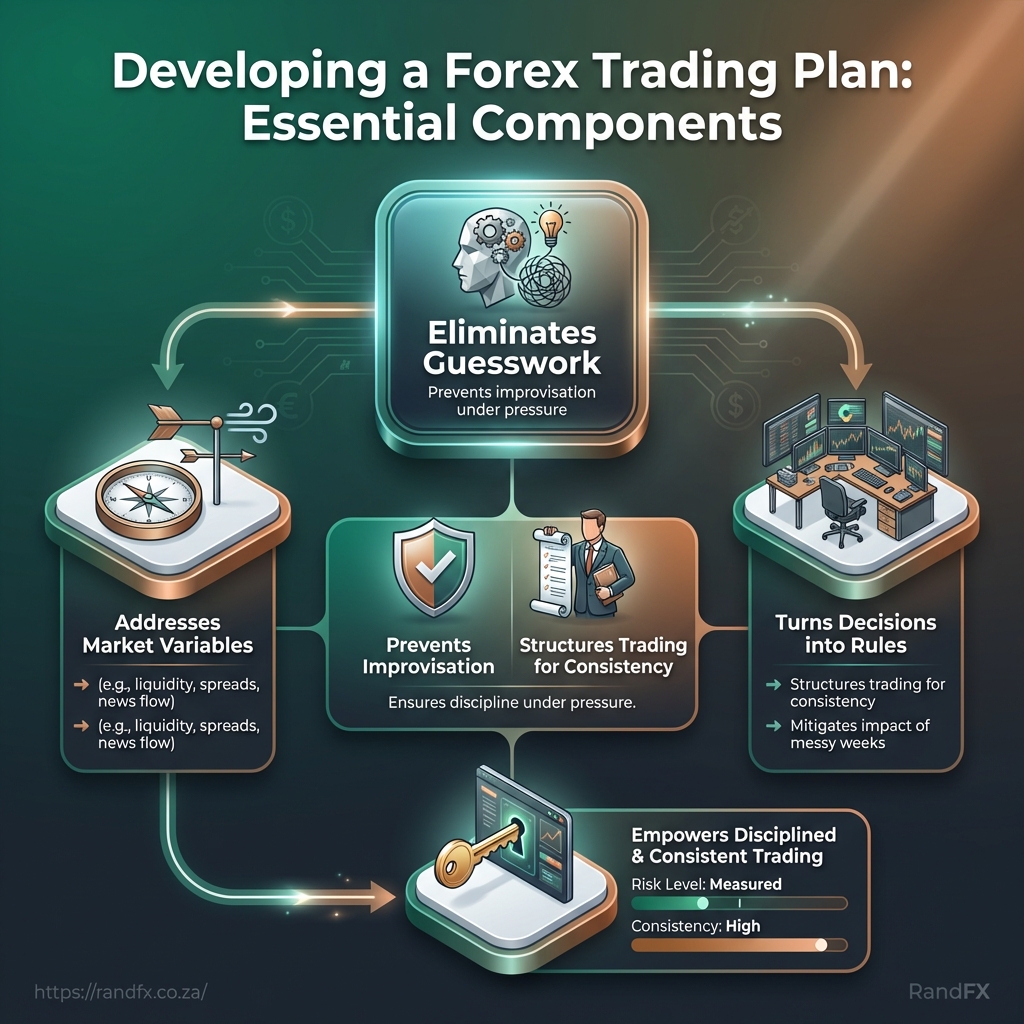
A solid plan forces the boring decisions first.
It spells out which pairs to trade, which sessions matter, and how risk management works when a stop gets hit.
It also separates signal timeframes from execution timeframes, so the chart logic stays clear when price starts moving fast.
That discipline is what keeps a rough week from turning into a wipeout.
Traders who last usually treat the plan like a living document: test it, track it, and change it only when the evidence is strong.
Foundations of a Forex Trading Plan
What if the problem is not your entries, but your plan’s maths? A forex plan lives or dies on two choices: what you want from trading and how much pain your account can absorb before you step back.
That matters because forex is huge.
The BIS estimated average daily global turnover at USD 6.6 trillion in 2022, so liquidity is deep, but fast moves and spread changes still punish vague plans.
A growth-focused trader and an income-focused trader usually need different setups.
Growth plans often allow longer holds and wider stops, while income plans tend to demand cleaner entry rules and tighter control of open risk.
Risk tolerance is the guardrail.
If your account is 5,000 and you risk 1% per trade, your maximum loss is 50.
If your stop is 25 pips, your size has to stay small enough that one stop-out still fits the plan.
- Risk per trade: Keep it near
1%of account equity, especially while the plan is still unproven.
- Drawdown limit: Many traders cap total account drawdown at
5%to10%before pausing and reviewing.
- Position sizing: Use
position size = account risk÷ stop-loss distance, then check that the result fits your margin room.
Trading goals and timeframes
| Timeframe | Typical Holding Period | Required Capital | Best-suited Strategy |
|---|---|---|---|
| Scalping | Seconds to minutes | $500–$2,000+ | Liquid major pairs during active sessions |
| Day Trading | Minutes to hours | $1,000–$5,000+ | Intraday breakout or momentum setups |
| Swing Trading | 2 days to 2 weeks | $2,000–$10,000+ | Trend-following or pullback entries |
| Position Trading | Weeks to months | $5,000+ | Macro trend or carry-style approaches |
| Hybrid | Mix of intraday and multi-day holds | $1,000–$5,000+ | Higher-timeframe bias with lower-timeframe entries |
Swing and hybrid plans are usually easier to live with, especially if you cannot watch charts all day.
For a simple starting point, a trader with 5,000 might risk 50 per trade, stop after a 5% drawdown, and test one timeframe first.
That keeps the plan honest and makes mistakes cheap.
A solid plan should fit your goals, your schedule, and your account size before it fits any chart pattern.
When those three line up, the rest of the work gets much simpler.
Market Research and Strategy Selection
What if the best strategy is the one that fits your schedule, not the one with the flashiest equity curve?
That question matters because forex is enormous.
The BIS estimated average daily turnover at USD 6.6 trillion in 2022, so the market rewards precision, but it also punishes vague rules.
A strategy that looks clean on paper can fall apart once spreads widen, news hits, or your broker fills badly.
A good first pass is to match the strategy to the way price actually behaves.
Trend trading wants momentum.
Mean reversion wants stretches that snap back.
Carry trades care about interest rate gaps more than chart patterns.
Strategy fit at a glance
| Strategy | Best Timeframe | Key Indicators/Tools | Trader Profile Fit |
|---|---|---|---|
| Trend Following | H1 to Daily | Moving averages, ADX, price structure | Patient traders who can sit through pullbacks |
| Breakout | M15 to H4 | Range levels, volume, ATR, session highs/lows | Fast decision-makers who can act on alerts |
| Mean Reversion | M5 to H1 | Bollinger Bands, RSI, support/resistance | Traders who prefer frequent, smaller setups |
| News-Based | Minutes to H1 | Economic calendar, spread watch, volatility tools | Experienced traders comfortable with sharp moves |
| Carry/Interest Rate Play | Daily to Weekly | Swap rates, central bank policy, rate differentials | Longer-horizon traders who think in months |
Breakouts tend to shine around session opens or after long consolidations, though false breaks are the tax you pay for excitement.
Mean reversion is the opposite story; it needs a range, not a runaway move.
Backtesting should start with clean historical data from the platform you actually trade on, then widen out to broker data or futures data from CME Group if you want a second check on execution realism.
For spot traders, platforms like MetaTrader 5 and TradingView are common places to test ideas before risking cash.
A broker comparison tool like Compare forex brokers becomes useful when the strategy depends on spreads, swaps, and order handling.
A serious test needs more than a handful of lucky trades.
Aim for at least 100 trades, and 200 or more is better if the setup is low frequency.
Watch expectancy, max drawdown, and win rate, but read them together; a high win rate can still hide terrible losses.
Forward testing is the reality check.
Run the rules in a demo or tiny live account for a few weeks or months, then compare the live results with the backtest instead of trusting the spreadsheet alone.
The smartest traders do not chase every setup.
They choose one market behavior, prove it on data, and keep the rules tight enough to survive real trading.
Trade Execution Rules and Risk Management
What if the cleanest setup still loses money because the exit rules were written in pencil?
That happens more often than traders admit.
A good forex plan needs a trigger for entry, a trigger for exit, and a stop that sits where the idea is wrong, not where the pain feels annoying.
A stop also has to respect market structure.
In practice, that means placing it beyond a swing high or low, or using a volatility yardstick like ATR(14) so the stop is not crushed by normal noise.
The other trap is crowding risk into one currency theme.
Two trades that both depend on the same base currency can behave like one oversized position, especially when news hits and spreads widen fast.
- Entry rule: Define one condition that starts the trade, such as trend filter plus breakout, and write it so it can be checked on the chart.
- Exit rule: Split exits into profit and failure cases, so partial profit-taking and full exits are both clear before the trade opens.
- Stop rule: Place the stop beyond structure or at
1.5 x ATR(14), then keep the distance fixed unless the trade plan itself changes.
- Risk cap: Limit each trade to a small fixed slice of equity, and cap total exposure on correlated pairs so one currency shock does not hit twice.
Position-sizing examples
Assuming a 25-pip stop on a USD-quoted major pair, where one standard lot is roughly USD 10 per pip, the math is simple.
| Account Size | Risk % per Trade | Dollar Risk per Trade | Example Stop Distance (pips) | Position Size (lots) |
|---|---|---|---|---|
| USD 1,000 | 1% | USD 10 | 25 | 0.04 |
| USD 5,000 | 1% | USD 50 | 25 | 0.20 |
| USD 10,000 | 1% | USD 100 | 25 | 0.40 |
| USD 50,000 | 1% | USD 500 | 25 | 2.00 |
| USD 100,000 | 1% | USD 1,000 | 25 | 4.00 |
1% can lose USD 100 and still stay on script.
If the stop widens to 50 pips, the lot size drops to 0.20, and the dollar risk stays the same.
That is the point.
The trade changes, but the damage does not.
Daily and weekly loss limits matter just as much.
A hard rule like 2% daily loss and 5% weekly loss, backed by an automatic stop on new entries, keeps a bad stretch from becoming a blown account.
The best execution rules feel boring in real time.
That is usually a good sign.
Record-Keeping, Performance Review, and Psychology
A trading plan gets much sharper when memory stops being the judge.
Traders usually remember the dramatic wins and the annoying losses, not the boring pattern in between.
That is exactly why the journal matters.
The BIS Triennial Survey put average daily global forex turnover at USD 6.6 trillion in 2022, and that scale means small habits get repeated fast.
If the same mistake appears ten times, it is no longer bad luck.
> A clean record beats a vivid memory. It shows whether a loss came from the idea, the timing, or simply bad execution.
Trade journal fields that actually get used
| Column Name | Description | Example Entry | Why it Matters |
|---|---|---|---|
| Date/Time | Exact trade timestamp | 2026-03-18 08:15 SAST | Helps spot session patterns |
| Currency Pair | Instrument traded | EUR/USD | Keeps the review specific |
| Position Size | Units or lots traded | 0.20 lots | Shows if size drifted |
| Entry Price | Fill price on entry | 1.0842 | Needed for clean math |
| Exit Price | Fill price on exit | 1.0861 | Lets you measure real result |
| Stop-Loss | Planned protection level | 1.0818 | Shows if the plan was clear |
| Trade Rationale | Reason for taking the setup | London trend pullback | Reveals quality of decision-making |
| Session | Market window used | London open | Helps link results to liquidity |
| Rule Followed? | Whether the plan was obeyed | Yes | Separates skill from mistakes |
| Result in R | Outcome measured in risk units | +1.6R | Makes reviews consistent |
- Expectancy: Track it over 30 to 50 trades, not five.
- R distribution: Watch for too many tiny wins and large losses.
- Rule adherence: Count trades taken exactly as planned.
- Session breakdown: Compare London, New York, and quieter hours.
Psychology and the pre-trade reset
Revenge trading, FOMO, confirmation bias, and recency bias all love tired traders.
They thrive when the screen becomes personal.
A simple reset routine cuts them down.
One trader I reviewed stopped taking impulsive late-session entries after tagging every emotional trade for two weeks; the pattern was obvious before the excuse was.
- Capital check: Confirm the account is still within your comfort zone.
- Risk check: Make sure the trade fits your normal risk unit.
- Correlation check: Avoid stacking the same exposure twice.
- News check: Watch for scheduled releases that can jerk spreads.
- Plan alignment: Take the trade only if the setup matches the rules.
- Liquidity check: Trade when the pair is active enough to behave normally.
- Execution readiness: Enter only if your platform, order type, and attention are all clean.
After a drawdown, slow the rhythm before size changes.
Keep the same review time, take fewer trades for a short stretch, and mark every emotional decision in the journal.
That habit protects confidence without turning into denial.
The goal is not to feel better for a day; it is to make the next decision cleaner.
Tools, Brokers, and Operational Setup
What if the difference between a clean trade and a messy one is not the setup at all, but the plumbing underneath it?
A forex plan only works when the tools, broker, and account structure match the way you trade.
The global FX market still runs on enormous volume — the BIS put average daily turnover at USD 6.6 trillion in 2022 — so small choices about spreads, execution, and order handling can matter more than traders expect.
That is why the setup has to fit the job.
A trader running a simple manual strategy does not need the same stack as someone using an EA, API, or multi-session dashboard.
Essential tools and platforms
| Tool/Platform | Key Features | Typical Cost | Best For |
|---|---|---|---|
| MetaTrader 4 | Familiar interface, large EA and indicator library, strong broker support, straightforward order entry | Free on most brokers | Beginners, discretionary spot FX traders, EA users with older systems |
| MetaTrader 5 | More order types, better strategy tester, broader asset support, depth-of-market features | Free on most brokers | Traders who want more flexibility and testing depth |
| TradingView | Web-based charts, strong drawing tools, alerts, Pine Script, clean multi-device workflow | Free tier; paid plans add more alerts and features | Chart-heavy traders, part-time traders, multi-market analysis |
| Broker Proprietary Platform | Broker-specific pricing, account integration, simpler onboarding, sometimes better mobile flow | Usually free with an account | Traders who want fewer moving parts |
| VPS Provider | 24/7 uptime, lower latency, keeps platforms running when your laptop is off | Free with qualifying accounts or paid monthly | EA traders, copy setups, anyone holding live automation |
TradingView is hard to beat for chart work, but many traders still place orders through a broker platform or MT terminal.
Budget matters, but not in the cheap-vs-expensive way people assume.
A free platform with bad execution can cost more than a paid charting subscription, especially when spreads widen or orders slip around news.
A practical stack usually looks simple: chart in TradingView, execute in MT5 or the broker terminal, and run automation on a VPS if the strategy needs it.
- Manual day trader: TradingView or MT5, plus a broker with tight spreads.
- Swing trader: MT5 or a broker platform, with clean mobile access.
- EA trader: MT5, VPS hosting, and reliable expert advisor support.
- API user: Broker with documented API access and stable execution logs.
Broker selection and go-live checklist
A broker should pass a safety check before it ever gets your money.
For U.S. retail forex, the CFTC and NFA framework matters because it governs dealer conduct, disclosures, and oversight.
Outside the U.S., the regulator changes, but the logic stays the same: verify who watches the broker, then verify how they handle your orders.
Execution quality deserves the same attention as regulation.
Tight spreads look nice on a website, but slippage, re-quotes, and poor fill quality can turn a good strategy into a frustrating one.
- Verify regulation: Confirm the broker’s legal entity, regulator, and account protection terms.
- Check execution details: Look at order types, average spreads, slippage policy, and whether fills are market or instant.
- Test on demo first: Place the exact trades you plan to run, during your normal trading session.
- Fund small and verify withdrawals: Make a small deposit, then test the withdrawal process before scaling up.
- Record the live setup: Keep login details, platform version, server name, and margin rules in one place.
For some traders, a broker comparison resource such as Compare forex brokers helps narrow the field without guesswork.
Once the platform and broker are stable, the rest of the plan gets easier to follow.
Good setup removes friction.
Bad setup creates noise before the first trade even opens.
Implementation, Monitoring, and Continuous Improvement
A demo account is not proof.
It is a rehearsal, and the jump to live trading should feel boring, not heroic.
That shift works best in stages.
Start with the same rules you used in testing, then move to a small live size, and only scale when the numbers stay steady across different market conditions.
The forex market is huge, with the BIS estimating USD 6.6 trillion in average daily turnover in 2022.
That scale is exactly why a rollout needs discipline; liquidity is deep, but execution still changes fast around news, session opens, and thin hours.
- Demo to live with a gate. Move to a tiny live size only after the system has been forward-tested long enough to show rule discipline, not just a few lucky wins.
- Set minimum acceptance criteria. Require clean rule execution, stable average slippage, and no blow-up days before adding size.
- Scale in fixed steps. Increase position size only after several consecutive positive months, and freeze growth after any material drawdown.
- Document every change. Treat the plan like a versioned file, not a mood board.
Review cadence and version control
| Cadence | Tasks | Metrics to Review | Decision Outcome |
|---|---|---|---|
| Daily | Check fills, rule adherence, and open risk before the session starts. | Spread paid, slippage, open exposure, rule breaks. | Trade, reduce size, or stand aside. |
| Weekly | Scan trade tags and compare results by pair and session. | Win rate, average R multiple, news exposure, missed setups. | Keep, pause, or tighten a rule. |
| Monthly | Review strategy behavior across market regimes and compare live vs. test results. | Expectancy, drawdown, setup quality, execution drift. | Scale, hold size, or revise one variable. |
| Quarterly | Run a formal plan audit and test any proposed change on a small sample. | Sample size, regime performance, stability of edge. | Version update or retirement decision. |
| Annual | Decide whether the strategy still fits your account, time, and market conditions. | Long-run equity curve, max drawdown, consistency across quarters. | Retire, rebuild, or keep unchanged. |
They test one rule, one size change, or one execution tweak, then compare the new version against the old one.
That is where a broker comparison resource like za/brokers/broker-comparison/”>Compare forex brokers becomes useful, because live rollout depends on spreads, execution quality, and account conditions.
Keep the plan versioned, keep the review dates fixed, and let the numbers do the arguing.
A Written Plan Beats a Perfect-Looking Chart
The most useful thing to remember is simple: a forex plan only works when it survives contact with real money.
Charts can look elegant, but without clear entry rules, risk limits, and a way to review mistakes, even a strong setup can turn into expensive noise.
That is why the traders who improve fastest are rarely the ones with the fanciest indicators; they are the ones who write things down and follow them.
The broker example matters here too.
A solid strategy can still feel broken if execution costs, platform stability, or order handling are working against it, which is why broker choice belongs inside the plan, not outside it.
That same logic applies to journaling and review: the trade itself is only part of the story, and the pattern behind your decisions usually tells the real truth.
Write down the one rule you break most often today. Then compare it against your current setup, your broker, and your risk limits with a clear head.
If that raises a few uncomfortable questions, forex brokers in south africa and tighten the pieces that sit between your strategy and your execution.