

What if the trade looked perfect, the setup was clean, and the market still punched a hole in the account? That is how most traders learn that risk management is not a side topic.
It is the part that decides whether one bad run becomes a setback or a full reset.
The forex market is enormous.
As of 2022, average daily OTC turnover was $7.5 trillion, which tells you how liquid it is and how quickly money moves through it.
Liquidity helps with execution, but it does not protect against leverage, slippage, or a careless entry size.
The real danger usually comes from small mistakes repeated too often.
A too-tight stop-loss, oversized position, or ignored margin level can turn normal price noise into a painful loss.
Once drawdown starts stacking, emotion takes over fast, and revenge trading usually finishes the job.
That is why protecting capital matters more than chasing the next win.
A trader who controls loss size, respects volatility, and keeps exposure in line with account equity has a far better chance of staying in the game long enough to improve.
Foundations of Forex Risk Management
A trader can be right about direction and still lose money fast.
In forex, that usually happens when the position is too large, the stop is too tight, or leverage turns a small wobble into a painful hit.
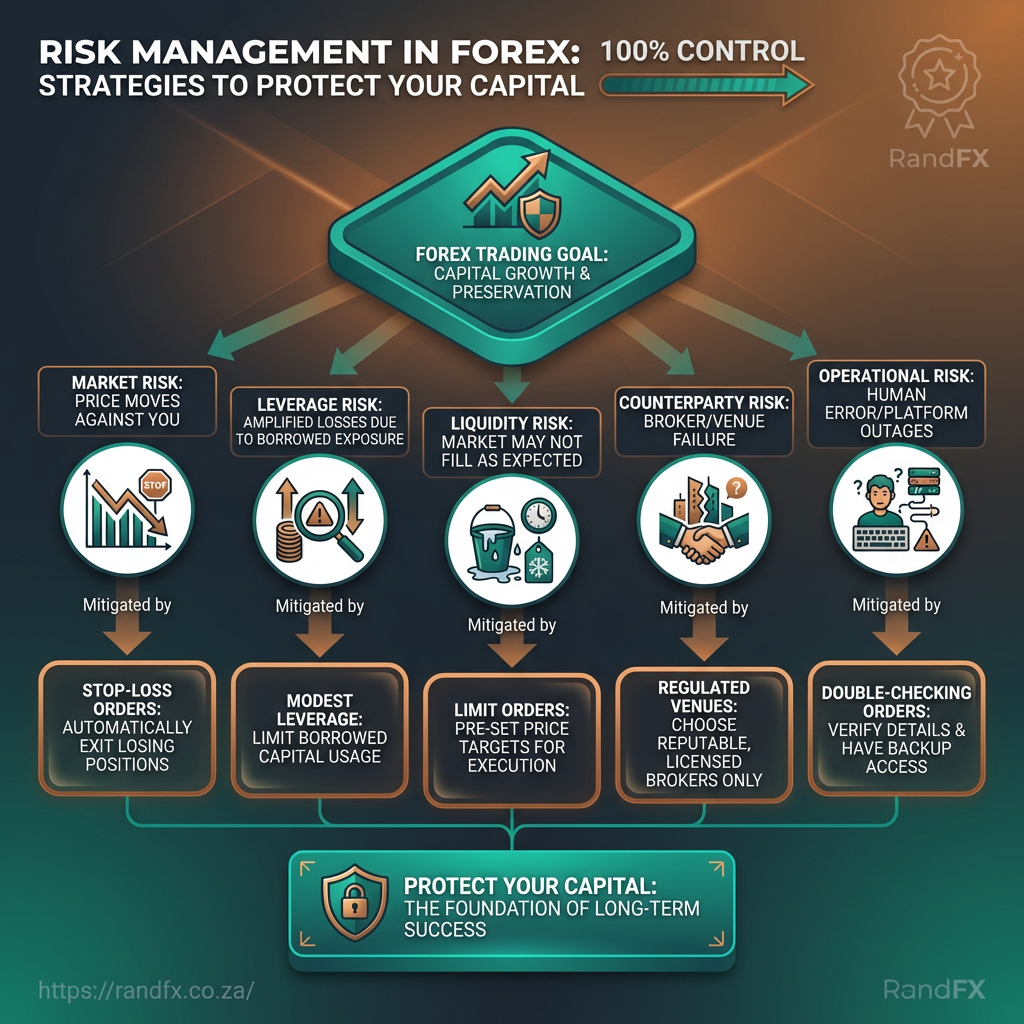
Risk in forex is not just “price went against me.” It also includes execution slippage, margin pressure, platform mistakes, and counterparty issues.
The 2022 global OTC FX market averaged about $7.5 trillion in daily turnover, so liquidity is deep, but deep markets do not protect over-sized accounts.
The smartest habit is to measure risk before entry.
Once the trade is open, the damage is usually mechanical, not mysterious.
What forex risk looks like
| Risk Type | Definition | Trader Impact | Mitigation Example |
|---|---|---|---|
| Market Risk | Loss from adverse currency price movement | A pair moves against the position and reduces equity | Use a stop-loss and reduce size before major news |
| Leverage Risk | Losses are amplified by borrowed exposure | Small moves can trigger large percentage losses | Keep leverage modest and tie size to account equity |
| Liquidity Risk | Difficulty entering or exiting at expected prices | Wider spreads and slippage can worsen fills | Prefer limit orders when conditions are fast or thin |
| Counterparty Risk | The broker or venue fails to meet obligations | Delayed settlement or unreliable execution can distort results | Use regulated venues and review broker disclosures |
| Operational Risk | Errors from the trader, platform, or process | Wrong order size, missed stop, or bad ticket entry | Use pre-trade checklists and platform order templates |
That table matters because each risk behaves differently.
Market risk is about direction, while leverage risk is about scale.
Liquidity, counterparty, and operational risks can all hurt even when the trade idea is sound.
The metrics worth tracking
Position size starts with a fixed loss rule.
If the account is $10,000 and the max risk is 1%, the trade can lose only $100.
If the stop-loss is 50 pips away, the lot size must be set so that 50 pips equals that $100 limit.
position size = max dollar risk ÷ stop distance
Maximum drawdown matters just as much.
A strategy that suffers a 25% drawdown needs a far bigger gain just to recover, so drawdown tells us whether the system is survivable, not just profitable on paper.
ATR, or average true range, helps when the market is jumpy.
A quiet pair may need a tighter stop, while a volatile one needs more room so normal noise does not knock it out.
A practical setup is to place stops near a multiple of ATR, then adjust size so the dollar risk stays constant.
A sane forex plan always starts with the loss side.
Once that part is clear, everything else gets easier to judge.
Position Sizing and Money Management Rules
A trader can be right three times and still wreck an account on the fourth trade if the size is sloppy.
That is why position sizing matters more than the entry itself.
In forex, the market can move fast, and the BIS reported about $7.5 trillion in average daily OTC FX turnover in 2022, which shows how liquid the market is while also hiding how quickly leverage can punish bad sizing.
Rules-Based Sizing That Actually Holds Up
The cleanest approach is simple: decide the most you can lose first, then size the trade around that number.
Use this formula for major pairs:
position size (lots) = risk amount / (stop distance in pips × pip value per standard lot)
For most major pairs, a standard lot is roughly $10 per pip, so a 50-pip stop with a $100 risk budget gives 0.20 lots.
That is the kind of math that keeps the trade honest.
Set equity first: Use current account balance, not wishful thinking.
Pick a max risk percent: Many traders use a small slice of equity, then let the stop define the size.
Convert the stop into dollars: Multiply stop distance by pip value.
Round to a tradable lot size: Most brokers will want clean increments.
Sample Position Size Calculations
| Account Size | % Risk | Risk Amount (USD) | Stop Distance (pips) | Position Size (lots) |
|---|---|---|---|---|
| $1,000 | 0.5% | $5 | 50 | 0.01 |
| $5,000 | 0.75% | $37.50 | 50 | 0.08 |
| $10,000 | 1% | $100 | 50 | 0.20 |
| $25,000 | 1.5% | $375 | 50 | 0.75 |
| $50,000 | 2% | $1,000 | 50 | 2.00 |
The numbers show something useful: position size should rise with equity, but only when risk stays controlled.
Fixed-dollar sizing works well for beginners who want one clean loss limit, while percent-based sizing adapts better as the account grows.
Kelly sizing looks clever on paper, but it is usually too aggressive for retail traders.
The problem is simple: your edge estimate is never as precise as the formula assumes, so full Kelly often asks for too much size too soon.
Keep the Whole Book Small
Two highly correlated trades can behave like one oversized bet.
If you are long EUR/USD and long GBP/USD, you are not really diversified in the way your P/L might suggest.
The same idea applies when several positions all depend on the same USD move, because correlation turns separate trades into one larger exposure.
Cap related risk: Treat strongly correlated pairs as shared exposure, not separate bets.
Watch effective leverage: Beginners usually do better staying near 2:1 to 3:1 effective leverage.
Keep a daily loss ceiling: A hard stop for the day prevents revenge trading from turning one bad session into a crater.
Prefer lower leverage on news days: Central bank decisions and inflation releases can blow through tidy assumptions fast.
That discipline matters even more in a market this liquid.
High turnover does not protect a small account from a bad leverage decision.
A sane money plan feels boring.
That is usually a good sign.
Stop-Losses, Take-Profits and Order Placement
What if the trade idea is right, but the exit is sloppy? That is where good setups quietly die.
A stop that sits inside normal noise gets clipped.
A target that ignores spread and slippage looks neat on paper and messy in live trading.
The cleanest approach is to match the stop method to the market structure. ATR-based stops breathe with volatility, technical stops sit beyond chart levels that matter, and fixed-percentage stops stay simple when you need consistency more than elegance.
Platforms like MetaTrader 4 and MetaTrader 5 make it easy to pre-set both stop-loss and take-profit levels before the order goes live.
Choosing the right stop-loss method
| Stop Method | How It Works | Pros | Cons |
|---|---|---|---|
| ATR/Volatility-based | Places the stop a set multiple of Average True Range away from entry. | Adapts to changing volatility; less likely to get clipped in busy markets. | Needs an ATR setting; can widen stops during fast markets. |
| Technical Structure-based | Sets the stop beyond a swing high, swing low, support, or resistance level. | Fits the chart; often avoids false exits around obvious levels. | Can be too tight if the level is crowded with noise. |
| Fixed-percentage | Uses a fixed distance, such as a set percent of price. | Simple and fast; easy to repeat. | Ignores volatility and can be badly placed in some pairs. |
| Time-based stop | Closes the trade after a set period if price goes nowhere. | Useful for short-term setups and stale trades. | Can exit before the move develops. |
| Trailing stop | Moves the stop behind price as the trade improves. | Protects open profit while leaving room for trends. | Can lock in too early if the trail is too tight. |
ATR works best when the market is jumpy.
A technical stop makes more sense when the chart has a clear shelf, like a breakout retest or a prior swing point.
Fixed-percentage stops are easiest to apply, but they often miss the real rhythm of the pair.
Placing the order without getting nicked
A market order gets you in now.
A limit order waits for your price.
In spread-heavy or fast conditions, that difference matters more than most traders want to admit.
Use market orders for fast-moving breakouts.
You get filled quickly, but expect some slippage if price is racing.
Use limit orders for planned pullbacks.
You control entry price better, though the trade may never fill.
Place stops beyond spread and noise.
A stop sitting exactly on a level is asking to be picked off.
Set the target before entry.
A clean setup might use a 1:2 reward-to-risk profile, such as entry at 1.0850, stop at 1.0825, target at 1.0900.
A practical EUR/USD example: buy at 1.0850, stop at 1.0824, target at 1.0902.
The stop sits below the recent swing and leaves room for spread.
The target is placed at the next visible resistance, not wherever the chart happens to look tidy.
The real edge comes from consistency.
Once the stop method and order type fit the setup, the trade stops feeling improvised.
Strategy-Specific Risk Controls
A day trader on a central-bank morning can be right on direction and still get clipped in seconds.
That is usually not a market skill problem; it is a strategy mismatch.
The market itself is enormous.
The BIS reported $7.5 trillion in average daily OTC foreign exchange turnover in 2022, which tells you how liquid FX is overall, but not how forgiving it is for a specific trade held at the wrong time.
Strategy-specific controls matter because each style fails in a different way.
A session trader needs escape hatches before the day turns messy, while a swing trader needs room for calendar shocks.
A carry trader watches rollover and macro drift, and an algorithm needs guardrails that keep a bug from becoming a blow-up.
A broker comparison like compare forex brokers is useful here, because margin terms, execution quality, and platform tools can change how those controls actually behave in live trading.
Risk controls by trading style
| Risk Control | Day Trading | Swing Trading | Carry Trading | Automated Trading |
|---|---|---|---|---|
| Gearing Recommendation | Keep gearing low and size for one session only. | Moderate gearing, with room for overnight noise. | Conservative gearing, since macro gaps and rollover matter more. | Hard caps on symbol and account exposure. |
| Stop Placement | Place stops outside normal intraday noise. | Place stops beyond structure and scheduled releases. | Use wider exits or hedge with futures/options when needed. | Use rule-based stops plus a circuit breaker. |
| Max Daily Loss | Set a firm session loss limit and stop trading once hit. | Use a daily cap, plus a weekly drawdown cap. | Focus on drawdown bands, not just one-day losses. | Add daily loss locks and error-based shutdown rules. |
| Automation Safeguards | Filter out news spikes and spread widening. | Use calendar alerts and order confirmations. | Monitor rollover cost and macro event risk. | Add watchdogs, reconnect logic, and order-rate limits. |
| Position Holding Time | Flat before major releases and before the session ends. | Hold for days, but review around event risk. | Match holding time to the macro view and swap schedule. | Set a maximum holding window so stale signals do not linger. |
Day traders live inside the clock.
A time stop helps them avoid turning a clean setup into a news gamble, and a hard daily loss limit keeps one rough morning from becoming a revenge-trading spiral.
Swing traders need a different kind of discipline.
The trade can look fine on the chart and still be vulnerable to inflation prints, central bank remarks, or a surprise gap on Monday morning.
Carry traders sit in a slower lane, but the danger is sneakier.
Rollover costs, policy shifts, and widening rate differentials can erase the edge, so some traders pair spot exposure with exchange-traded FX futures or options through venues such as CME Group or ICE Futures Europe.
Automated systems need the most mechanical discipline of all.
Bugs, disconnects, duplicate orders, and runaway loops do not care about your thesis, which is why fail-safes matter more than confidence.
When the rules fit the strategy, the trade feels calmer and the account stops getting punished by avoidable mistakes.
That calm is worth a lot more than a flashy setup.
Psychology and Discipline in Risk Management
What if your entries are fine, but your head keeps sabotaging them?
That is a far more common problem than traders admit.
In a market that handled about $7.5 trillion in average daily OTC FX turnover in 2022, the bottleneck is rarely opportunity.
It is usually behavior.
As of 2022, average daily OTC foreign exchange turnover was about $7.5 trillion.
Emotional triggers show up fast
A missed move can trigger FOMO in minutes.
A small loss can trigger revenge trading just as quickly.
A good run can be dangerous too, because overconfidence has a habit of making rules feel optional.
The fix is not mystical.
It starts with spotting your trigger pattern before the trade starts, then forcing a pause when the pattern appears.
FOMO: Wait for the next setup, not the next candle.
Revenge trading: Step away after a loss and clear the screen.
Boredom trading: Trade only when your plan says the setup is valid.
Euphoria: Reduce size or stop for the day after a streak.
A written trading plan matters here because it removes improvisation.
If the rule is clear, the emotional debate gets shorter.
Discipline is mostly boring, which is good
Good traders build routines that make bad decisions harder.
That usually means a pre-market checklist, a fixed review time, and a hard stop for trading when the day gets messy.
Journaling helps because it turns vague regret into usable data.
A useful journal entry records the setup, the reason for entry, the rule followed or broken, and the emotional state at the time.
Write the trade idea before entry.
Capture a screenshot after entry and after exit.
Mark any rule break immediately.
Review the trade once, at the same time each day.
Write one adjustment for the next session.
Alerts can do some of the emotional heavy lifting too.
Price, margin, and session alerts in tools like MetaTrader 4 and MetaTrader 5 reduce the urge to stare at the screen and react to every twitch.
For traders who want a clearer rules framework, resources like compare forex brokers can help when evaluating which platform setup fits disciplined execution.
The traders who last are not the ones who feel nothing.
They are the ones who build habits that work even when they do.
Risk Tools, Broker Considerations and Practical Checklists
A trader can have a good setup and still get hurt by the broker’s plumbing.
A slow fill, a wide spread, or a harsh margin policy can turn a decent trade into an avoidable loss.
That is why broker choice belongs in risk management, not in a separate shopping basket.
Services like compare forex brokers become useful here because the real question is not “who is cheapest,” but “who helps protect capital when markets get messy.”
Tools and Broker Features That Reduce Risk
| Broker Feature | Benefit for Risk Management | Where to Check (Broker Docs) | Recommended For |
|---|---|---|---|
| Guaranteed Stop-Loss | Caps downside even if price gaps through your level | Order types page, risk disclosure, product schedule | Traders who hold through news or illiquid sessions |
| Negative Balance Protection | Helps prevent losses from going below account equity | Client agreement, margin policy, regulatory disclosures | Retail traders using leverage |
| Execution Speed / STP vs Market Maker | Faster, cleaner fills reduce slippage and rejection risk | Execution policy, order handling notes, pricing model page | Traders who enter during volatile moves |
| Leverage Options | Lower leverage reduces margin pressure and liquidation risk | Leverage table, account types page, terms and conditions | Newer traders and smaller accounts |
| Margin Call Policy | Clear rules make it easier to spot danger early | Margin policy, liquidation rules, FAQ | Anyone trading with borrowed buying power |
A broker that publishes these details clearly usually takes risk more seriously.
A broker that buries them in fine print deserves a harder look.
Pre-Trade, Daily, and Weekly Checks
Before a trade, the checklist should be boring on purpose.
Confirm the stop level, the dollar risk, the spread, the leverage used, and whether the broker’s order type matches the plan.
After the trade day, the review should focus on process, not feelings.
Look for repeated slippage, trades taken during bad liquidity, margin usage that crept too high, and any rule that was ignored under pressure.
Pre-trade check: Stop placed, size correct, spread acceptable, margin comfortable, and event risk noted.
Daily check: Loss limit respected, fills reviewed, and no revenge trades entered.
Weekly check: Biggest losers grouped by cause, execution problems flagged, and drawdown compared with the rulebook.
After a drawdown: Cut size, tighten trade filters, and pause any setup that broke twice in a row.
A useful habit is to write one sentence beside every rule: what it protects you from.
That keeps the checklist practical instead of decorative.
The strongest risk systems are rarely flashy.
They are the ones that make bad surprises smaller and recovery faster.
Conclusion
The Trade Is Rarely the Problem
What usually breaks a trader is not a bad setup.
It is a good setup with the wrong size, a loose stop, or a broker that makes execution messy at the worst moment.
That was the real lesson running through every part of this guide: risk management is the shield, not the decoration.
Think back to the simple case of a trade that looks textbook-perfect, but a 2% account risk turns into 6% because the lot size was guessed instead of calculated.
Once that happens, discipline gets harder, not easier.
The traders who last treat position sizing, stops, and broker choice as one system, not separate chores.
Do one thing today: pick your next planned trade and write down the exact amount you can lose before entry.
Then compare execution conditions, spreads, and account terms with Compare forex brokers in south africa before you place it.
That one habit turns risk management from theory into something you can actually trust.