
It’s frustrating when trades almost work out and gains keep dwindling.
A well-kept trading journal changes those frustrating moments into clear, testable data, rather than relying on vague memories.
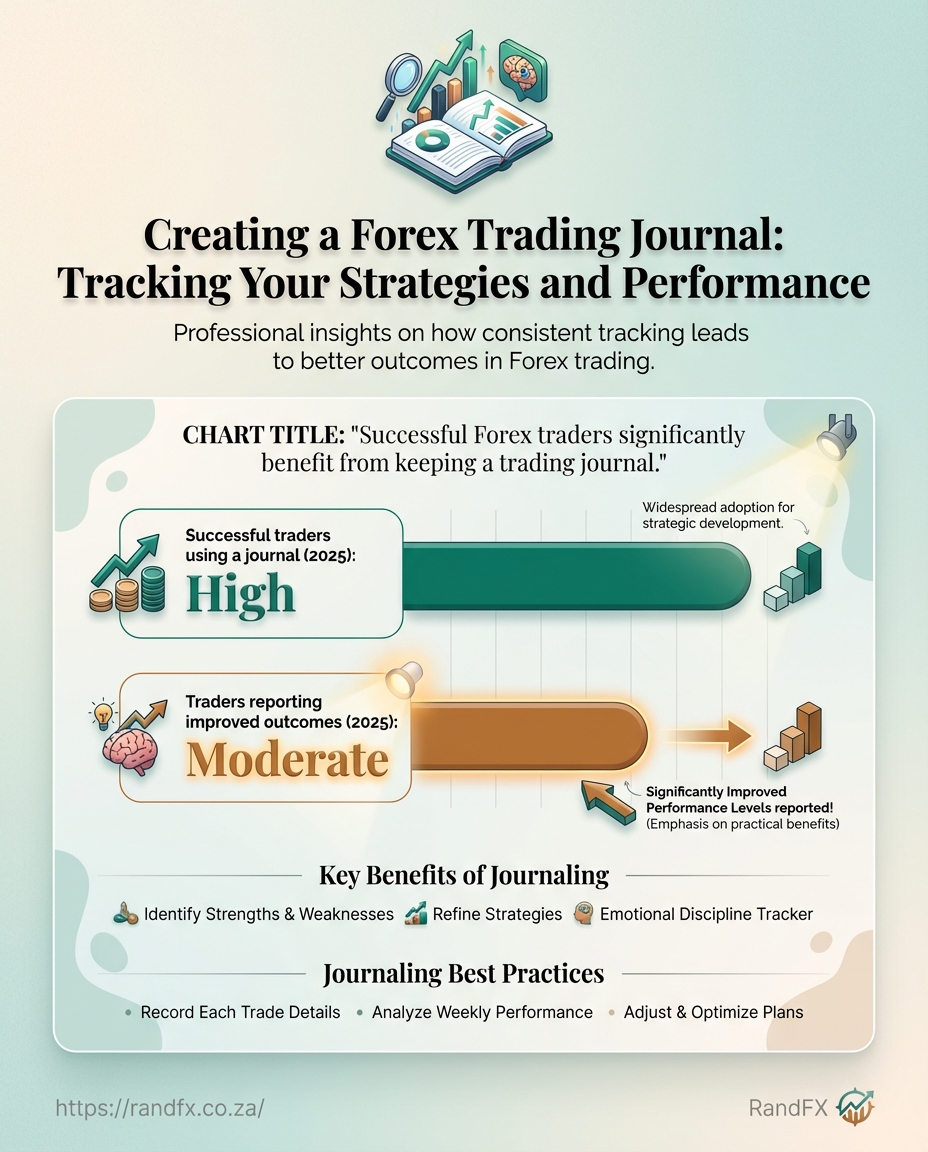
In 2025, 72% of successful Forex traders said a journal played a major role in their progress.
Another 87% of respondents in the same analysis reported that keeping records improved their trading outcomes.
A journal is more than just a logbook.
It combines trade reviews with statistical analysis and an emotional record.
Recording setups, entry and exit reasons, position size, and feelings at the time exposes patterns spreadsheets alone miss.
In this guide, we will cover the key reasons for keeping a Forex trading journal, what to include, how to structure it, and common pitfalls to avoid, ensuring you can maximize your trading performance.
Why Keep a Forex Trading Journal
Many traders believe a journal is only for successful traders and spreadsheets.
That’s misleading.
A properly maintained journal is the key tool that transforms random luck into a skill that can be repeated.
In 2025, 72% of successful Forex traders said their journals were a major factor in performance.
The same year, 87% of respondents reported that keeping records improved their trading outcomes.
Those numbers aren’t decoration — they point to a habit that separates traders who learn from traders who repeat mistakes.
Keeping a journal changes how decisions get made.
It forces you to record the trade rationale, emotional state, and outcome, which interrupts biased loops and grazing impulses.
Over time the journal becomes a feedback engine for both psychology and strategy.
Psychology and Accountability
Emotions cause predictable mistakes: revenge trading after a loss, overconfidence after a streak, and fear-driven exits.
Writing down what you felt and why you pulled the trigger creates a pause that breaks the automatic pattern.
- Emotional snapshot: Log mood, stressors, and confidence before each trade.
- Trade rationale: Note the setup, signal, and rule you followed.
- Accountability check: Review missed rules weekly and tally violations.
A practical daily habit: spend five minutes after market close writing one sentence about what went well and one lesson.
Do this for 30 days; it becomes a reflex.
Performance Measurement and Continuous Improvement
Metrics turn feelings into fixes.
Track a few core numbers from every trade so the data guides your tweaks instead of gut feelings.
Use platforms like MetaTrader 4 or TradingView to export trade records and speed up analysis.
Performance Measurement and Continuous Improvement
Collect clear data, analyze a single metric, then adapt rules and size.
A simple iteration cycle works well: collect every trade, analyze the one or two metrics that matter, and adapt a single rule.
Repeat continuously.
A journal is not busywork; it’s the engine that converts experience into improvement.
Keep it short, consistent, and honest — the results follow.
What to Include in Your Trading Journal
Want trades to teach you something instead of repeating the same mistakes? The right fields turn raw trade data into patterns you can act on.
A good journal captures not only the mechanics of each trade but also the reasons behind them and how you felt at the time.
A journal is a mix of hard numbers and soft context.
Numbers give performance clarity; context explains why a number looks the way it does.
A clear example entry and consistent formats save hours when you analyze months of trades.
> 72% of successful Forex traders in a 2025 survey credited their progress to keeping a trading journal; 87% in the same year said recording trades improved their outcomes.
Core Fields (must-have)
| Journal Field | Description | Example | Priority |
|---|---|---|---|
| Date/Time | When the trade was opened (use time zone) | 2026-03-18T14:30Z |
Must-have |
| Instrument | Currency pair or instrument traded | EUR/USD | Must-have |
| Entry Price & Type | Exact entry price and order type | 1.0865 — market |
Must-have |
| Exit Price & Result | Exit price plus result in pips and currency | 1.0840 — Exit -25 pips / -$125 | Must-have |
| Position Size / Risk % | Lot size and percent of account risked | 0.5 lot / 1% risk | Must-have |
| Stop Loss | Hard stop price and reason | 1.0890 — technical resistance | Must-have |
| Take Profit | TP price and target rationale | 1.0820 — support test | Must-have |
| Trade Duration | How long position was held | 2 hours 15 minutes | Must-have |
| Setup / Rationale | Short description of setup and trigger | Breakout from range after retest | Must-have |
| Emotional State / Notes | Trader mood and notable distractions | Frustrated; trading after loss | Must-have |
| Strategy Tag | Which strategy or system was used | Mean-reversion v2 | Must-have |
| Broker / Account | Broker name and account type for record | HFM — Standard account | Must-have |
Use consistent naming so filters and pivots work when you query months of trades.
For checking brokers and spreads, see Compare forex brokers.
Formatting tips
ISO dates make sorting reliable.
Use YYYY-MM-DDTHH:MMZ so time-zone shifts don’t scramble results.
Record results in pips and local currency.
That lets you compare the same setups across instruments.
Round prices consistently: use the same decimal places per instrument.
Separate numeric fields: keep price, pips, and dollar impact in distinct columns.
Use short, consistent tags: BRK for breakouts, MR for mean-reversion.
Advanced fields (optional but high-value)
Adding a few optional fields speeds learning and segmentation.
Screenshot link: paste chart image URL for visual replay.
Order ID: platform order reference for reconciliation.
Economic event: tag if trade near an announcement.
Pre/post-trade checklist result: note whether checklist was followed.
Peer/room tag: mark trades done in community sessions for comparison.
Screenshots are worth the upload time when you revisit trades months later.
Platform exports from MetaTrader 4 or TradingView can fill many numeric fields automatically, leaving you to record rationale and emotions.
A tight journal template pays for itself with clearer edits to strategy and fewer repeating mistakes.
How to Structure the Journal: Tools and Templates
Ever wondered why some traders learn fast while others repeat the same mistakes? The structure you give your journal determines how easily patterns surface and how quickly you can act.
A journal should be effortless to use after a long trading day.
That means picking either a manual spreadsheet you can shape exactly how you trade, or an automated tool that captures trades and metrics without extra typing.
Both approaches work — the choice comes down to control versus convenience.
Most successful traders make the journal part habit, not a chore.
A tidy structure reduces friction and turns raw entries into reliable signals you can test.
Manual Options — Spreadsheets & Printable Templates
Start with a simple layout and add complexity only when you need clearer signals.
Spreadsheets let you track every micro-decision, run pivot-table reviews, and keep offline copies for privacy.
- Set up columns in this order:
Date,Pair,Direction,Size,Entry,Stop,Target,Exit,P/L (quote),Pips,Risk%,R:R,Notes. - Create a separate sheet called
Statsto aggregate results by pair, strategy, and session usingSUMIFSandCOUNTIFS. - Add conditional formatting: highlight losses > 2% of account and wins > 2R for quick visual cues.
Essential formulas and placements:
- Pips calculation: place in
Pipscolumn — use=ROUND((Exit-Entry)10000,0)for 4‑decimal pairs; adjust multiplier for 5‑decimal pairs. P/L (quote):= (Exit-Entry) Sizefor direct-quote pairs; adjust for inverse pairs or include aPipValuefactor. Risk %:= (Entry-Stop)PipValueSize / AccountBalanceto show position risk as a percent of equity.
P:L)` to compute wins/total.
Advantages of manual control are clear: total customization, offline security, and the ability to embed strategy notes next to raw calculations.
Manual template comparison
Manual Options — Spreadsheets & Printable Templates
| Template | Best for | Key features | Complexity |
|---|---|---|---|
| Basic trade log | New traders logging entries and exits | Simple columns (Date, Pair, Direction, Entry, Exit, Size, Notes); printable | Low |
| Intermediate (auto metrics) | Traders who want quick stats | Adds Pips, P/L, Risk%, pivot-ready Stats sheet, conditional formatting |
Medium |
| Printable daily checklist | Traders who want routine before/after trading | One-page pre-trade checklist and post-trade reflection prompts; printable PDF | Low |
The basic log gets you recording; the intermediate template automates metrics so analysis becomes routine.
The printable checklist enforces discipline and emotional notes without complex formulas.
Automated Options — Apps and Platform Integrations
Auto-journals remove busywork and often attach trades to the exact chart setup.
Platforms like MetaTrader 4 let you export trade history, and TradingView supports built-in ideas and journaling alongside charts.
When evaluating automation, focus on these criteria:
- Cost: choose free export options or paid apps with trial periods. Exportability: ensure CSV/Excel export for independent backups. Tagging: ability to tag by strategy, setup, or emotional state for later filtering.
- Sync: real-time broker integration versus manual import.
Privacy and data ownership deserve attention.
Cloud-based journaling is convenient, but confirm whether you retain full data ownership and can download all records.
Local CSV exports and encrypted local storage keep control in your hands.
Top automation patterns: 1.
Export trade history from MetaTrader 4 and import into your spreadsheet for hybrid control. 2.
Use TradingView’s journal features to attach trade notes to charts and export screenshots for evidence. 3.
Consider journaling apps that auto-sync via broker API but always verify export and deletion options.
A 2025 survey found that 72% of successful Forex traders credited journaling with improving their results.
Choose the structure that you will actually update.
Consistency beats perfection; a simple spreadsheet used every day will teach more than a perfect setup that sits idle.
Reviewing and Analysing Journal Data
Ever looked at a month of trades and felt like nothing jumped out? That’s normal—raw entries rarely reveal patterns until they’re actively analysed.
An effective review process can make a journal work like a performance engine.
Review work happens on two cadences: a monthly operations check to catch slippage, rule drift, and behavioral leaks, and a quarterly deep dive to test whether a strategy still has a real edge.
Those reviews should be repeatable, numeric, and tied to decision rules so emotion doesn’t steer the changes.
Reviewing becomes far more reliable when tied to simple statistical checks and clear thresholds.
Practical tools like MetaTrader 4 or TradingView make exporting the raw trade list easy, which lets you compute metrics, chart trends, and spot outliers rather than guess at causes.
The 2025 survey showed 72% of successful Forex traders crediting journals for their edge, which underlines how review discipline pays off.
Monthly Review — What to Check
Below is a concrete checklist you can run at month-end.
Compute most metrics from your exported trade list (entries, exits, position sizes, P/L) and compare to these thresholds.
Monthly Review — What to Check
| Metric | How to compute | Target/Threshold | Recommended action |
|---|---|---|---|
| Win rate | Wins / total trades | >40% for most systems | Investigate losing setups if below threshold |
| Avg RR (risk:reward) | Average reward / average risk per trade | >1.5 | Tighten exits or increase stop discipline |
| Expectancy (R per trade) | (Win rate × avg win R) − (Loss rate × avg loss R) | >0.1 R | Pause changes; focus on execution if below |
| Avg R multiple | Average net R per trade | Positive (>0) | Review distribution of large losers/winners |
| Max daily drawdown | Largest equity drop in a day | <2–3% of equity | Reduce size or enforce daily stop |
| Max monthly drawdown | Largest monthly drop | <10% of equity | Trim risk, review market regime fit |
| Consistency of position sizing | Std dev of position size / target size | <±10% | Fix position-sizing rules and enforce checks |
| Adherence to rules | Trades that match documented setup / total trades | >90% | Retrain discipline; mark rule-breaks in journal |
| Avg holding time | Mean time between entry and exit | Within planned holding window | Adjust strategy if time-on-chart drifts |
| Commission & fees impact | Total costs / gross P&L | <10% | Switch broker or adjust sizing if excessive |
Quick-win actions after review
- Close small leaks: If commission impact exceeds 10%, negotiate fees or reduce overtrading.
- Fix sizing drift: If position sizing varies >±10%, automate sizing in your platform.
- Enforce daily stop: If max daily drawdown breaches 3%, stop trading for specified recovery time.
- Rule audit: If adherence falls under 90%, tag and review rule-break trades with timestamped notes.
Quarterly Analysis — Strategy Decisions and Edge Validation
Quarterly reviews ask whether a strategy still produces a measurable edge and whether sample size supports that claim.
Aim for at least 50–100 trades before making sweeping changes; smaller samples produce noisy win rates and expectancy estimates.
Validate edge with simple checks: confirm positive expectancy, inspect the distribution of returns for large outliers, and calculate how sensitive profitability is to win rate or R changes.
Use confidence intervals on win rate and expectancy to see how stable results are over time.
- If expectancy remains positive and metrics stable, continue and scale carefully.
- If expectancy is marginal and variance high, reduce size and run tests with tighter controls.
- If expectancy turns negative with sufficient sample size, pause that strategy and backtest adjusted rules.
- If market regime appears to have shifted, map performance to macro events and decide on temporary suspension.
Quarterly discipline separates lucky runs from repeatable edges.
Regular, numeric reviews turn journal pages into decisions rather than opinions.
Common Pitfalls and How to Avoid Them
Ever flipped through a trading log that looked complete but quietly lied? Sparse, incomplete, or biased entries can create a misleading sense of progress.
That illusion costs edge faster than any bad trade.
Journals fail for two reasons most traders miss.
First, incomplete or emotionally biased entries hide repeatable mistakes.
Second, chasing vanity metrics and overfitting analysis makes a strategy look proven when it’s actually fragile.
Recent industry findings show this matters: in 2025, 72% of successful Forex traders credited their journals with their edge, and 87% said keeping records improved their outcomes.
Treating the journal like a truth machine is non-negotiable.
Incomplete Entries and Biased Recording
Sparse notes and post-hoc rationalisations are the silent killers of improvement.
When you enter only outcomes or only the “good” trades, the data skews and decisions follow the bias.
Minimal entry rule: Record the trade setup, time, entry, stop, target, position size, emotional state, and a one-line rationale at the moment you place the trade.
Contemporaneous entry: Write entries while the setup is fresh — within 5–15 minutes of execution.
Waiting invites revisionist storytelling.
Routine to reduce bias: Schedule a fixed journal session daily.
Close the trading day, then add 3 reflective bullets: what worked, what surprised you, and one behavioural change for tomorrow.
- Set a
5–15 minutetimer after each trade to force real-time entries — this prevents after-the-fact justifications. - Use structured fields (checkboxes + short fields) rather than freeform prose to lower omission risk.
- Apply a weekly “completeness audit” where you check for blank fields and score entries; expect <5% missing fields.
Overfitting and Vanity Metrics
Overfitting turns noise into a false strategy.
Vanity metrics flatter but don’t predict future performance.
Focus instead on , risk-adjusted measures and consistent sample sizes.
Overfitting and Vanity Metrics
| Vanity Metric | Why it’s misleading | Useful alternative | How to measure |
|---|---|---|---|
| Highest win rate filter | Picks only setups that once won, ignoring frequency and fairness | Expectancy (average return per trade) | Calculate mean R across trades and include sample size |
| Average trade size only | Hides distribution and skew; large winners can mask small frequent losses | Median trade and skew | Report median, mean, and max/min; plot distribution |
| Chasing cherry-picked setups | Selects best outcomes from many — not repeatable | Out-of-sample validation | Reserve recent trades or a forward test for validation |
| Ignoring drawdown depth | Misjudges capital needs and psychological tolerance | Maximum drawdown & recovery time | Track peak-to-trough equity and days to recovery |
| Focusing on total P/L without sample size | Big P/L on tiny sample is unreliable | Win rate with confidence intervals | Use binomial CI around win rate; require N≥50 for decisions |
| Relying on isolated best trades | Overweights rare outliers | Trimmed mean or winsorized mean | Recalculate averages excluding top/bottom 5–10% |
| Overweighting recent trades | Creates recency bias and unstable rules | Rolling performance windows | Compare 30/90/365-day metrics for consistency |
| Counting open positions as wins | Inflates perceived success | Realized performance only | Separate open vs closed P/L and report realized returns only |
| Using gross returns without fees | Overstates edge after costs | Net returns after fees/slippage | Subtract commissions, spreads, and estimated slippage per trade |
| Tracking only long trades | Misses directional bias and missed opportunities | Directional breakdown | Report long vs short performance and exposure time |
Use platforms like MetaTrader 4 or TradingView to export raw trade lists for these calculations.
Avoiding these traps keeps analysis honest and decisions defensible.
Keep entries complete, timestamped, and measured against metrics — your future self will thank you.
Turn journal insight into repeatable gains
The most valuable insight is simple: journal entries change hunches into measurable patterns you can act on.
That recurring pattern of nearly-right trades and shrinking gains becomes obvious once you log setups, rationale, emotion and outcomes consistently.
When the data replaces narrative, decisions stop being reactive and start being testable.
Experiment with those patterns: adjust one variable, try out ten setups, and see what happens.
If the experiment nudges performance, scale deliberately — increase size in small steps and keep strict stop rules.
Make a short weekly review part of your routine so insights compound instead of disappearing between losing streaks.
Today, pick one pattern from your journal and run one small experiment this week—define entry, stop, target, and sample size.
If you need a broker suited to controlled scaling, check forex brokers in south africa.
Which single pattern will you test first?